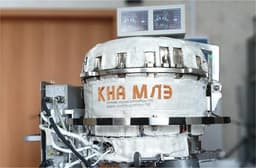
Scientists in Crimea have discovered over 750 asteroids using a modernized Soviet telescope. Astrophysicists have already gained priority in determining the orbits of 42 of them. This will allow specialists to name the asteroids.
When the Soviet Union and the world in general learned to make large telescopes with diameters of 5 m or more, it turned out that such instruments are very heavy, and therefore it was necessary to come up with some system to create new generations of lighter telescopes.
Otherwise, working with them becomes extremely difficult: it is difficult to aim at the target, and telescope maintenance generally causes many problems. Therefore, the technology of segmented optics appeared, which allows creating a large mirror from many individual elements.
It was successfully tested on the "Synthesis" telescope in the 70s. In addition, experiments were carried out at that time to create more complex technologies, for example, adaptive optics. Only those experiments were not as successful.
Currently, the research of Crimean scientists in the field of astrophysics is carried out using the "Synthesis" telescope - this is a Soviet project for the development of segmented optics.
Telescope Modernization
With the collapse of the Soviet Union, the development of technologies in the field of segmented optics stopped. The "Synthesis" telescope was left without funding and was not used. As a result, it was mothballed for about three decades.
In 2018, a group of scientists led by Nazarov received permission to modernize the telescope.
We managed to make a control system for this telescope, we wrote software, restored the Soviet mechanics, adjusted, debugged, and in 2021 the telescope started working for us.
To start scientific observations, specialists temporarily installed two small telescopes. One of them was placed on the "Synthesis" tube, and the second one was next to it. With the help of these instruments, they began to find new asteroids and actively study the core of the galaxy.
Earlier,www1.ru reported that Russian astronomers had solvedone of the key problems of astrophysics of the last two decades. They discovered spectral features that distinguish white dwarfs from neutron stars in X-ray accreting binary systems. Prior to this, specialists had information only that these objects differ from each other in their geometric and physical characteristics.
Read materials on the topic:
Condition for possible evacuation of cosmonauts from the ISS due to solar flares announced
The "Kazachok" landing module of the Mars exploration mission has returned to Russia