The Federal State Budgetary Institution "Main Northern Sea Route Administration" has summarized its two-year work on monitoring the Northern Sea Route (NSR). By order of the Russian government, it provides icebreaker support for ships, monitors their movement, and issues permits for ships to pass through the NSR.
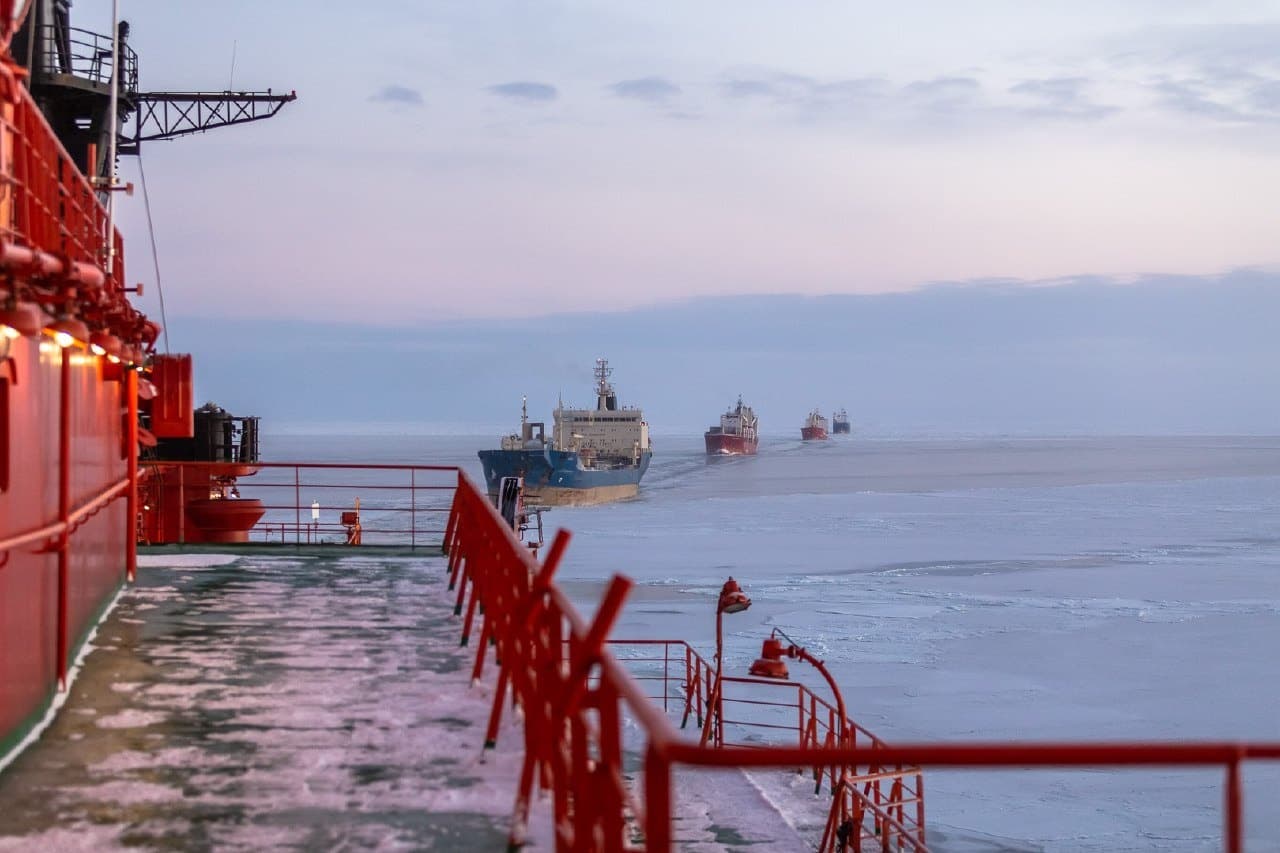
Since August 1, 2022, in the NSR water area:
- 2603 voyages were carried out;
- more than 2300 icebreaker support operations were organized;
- about 2400 navigation permits were issued;
- a convenient mechanism for submitting applications for ship navigation in the NSR water area through the State Services portal was introduced;
- emergencies were avoided - there have been no emergencies on the Northern Sea Route in two years.
Also, specialists from "Main Northern Sea Route Administration" developed and launched a unique deep-water route that allowed Capesize vessels to transit through the NSR water area. Capesize (translated from English cape - "cape", size - "size", editor's note) - large vessels with a deadweight of over 150 thousand tons. They carry coal, ore, and other similar heavy cargo, and require separate deep-water terminals to work with them. It is difficult for such vessels to pass through the Suez and Panama Canals, and they require alternative routes.
In September 2023, the dry cargo ship Gingo became the first conventional non-ice class Capesize dry cargo ship to be escorted by Russian icebreakers along the NSR from Murmansk to the east to China. The journey took only 13 days, which was twice as fast as via the Suez Canal.
The debutant Gingo delivered 164,600 tons of iron ore concentrate to China, and became the record holder for the transportation of a one-time volume of cargo ever transported along the NSR. Now this route is regularly used for the passage of ships of this type.
The Northern Sea Route is becoming increasingly popular outside of Russia. At the end of 2023, international transit along the NSR exceeded 2 million tons of cargo.
The number of customers for the information and navigation support service for voyages in the NSR water area has almost doubled in two years. If we had 9 contracts with customers in 2023, then in 2024 there are already 16, and their number continues to increase.
According to FSUE Atomflot, a subsidiary of the Rosatom State Corporation, during the winter-spring navigation of 2024, Atomflot's icebreakers provided 438 ship calls (compared to only 435 in the same period of 2023). The total gross cargo capacity amounted to 50.4 million tons (compared to 48.6 million tons in the same period of 2023).
Read materials on the topic:
Withstands cold up to −60 °C: a new weather and ice monitoring complex tested in the Arctic
Russian tanker "Pandar" repaired for operation on the Northern Sea Route
"Rosatom" will build high ice-class vessels with China
Severe "Rusak K-10": the first Arctic all-terrain vehicle on hydrogen presented in Russia











