Translated with AI from the Russian original.
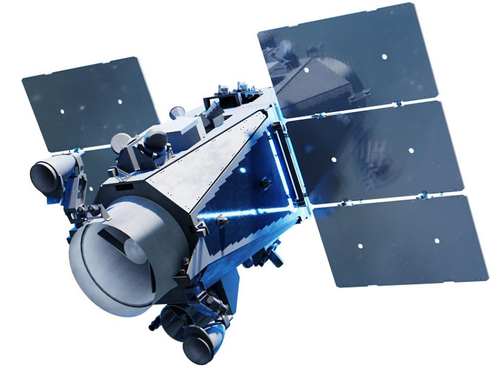
Gazprom's Smotr-V Earth remote sensing satellites have become one step closer. The Gazprom SPKA enterprise for the production of spacecraft will start operating in July. The first satellites will be created in cooperation with partners: private companies, the names of which are not disclosed.
According to Sergey Masalov, First Deputy General Director of Gazprom SPKA, at a meeting of the interdepartmental commission on the use of the results of space activities, the plant will be launched "in two weeks." Product testing will begin in August.
Now [we are discussing plans] with colleagues from private companies - they plan to reach two satellites per week in 2025.
At this rate, it is expected to reach the production of one hundred small devices per year.
The project to create satellites from PJSC Gazprom Neft became known in the fall of 2020. It was assumed that by 2022, an assembly production of spacecraft (SPKA) of Gazprom SPKA LLC would be erected in Shchelkovo near Moscow. It was supposed to produce not only Smotr-V Earth remote sensing satellites. Other civilian spacecraft were also planned in the interests of Roscosmos and other customers.
In 2024, the first copies of the Shchelkovo satellites were to be produced at the enterprise's facilities. And by 2035, Gazprom stated that it plans to launch fourteen of its own satellites into orbit: eight Yamal satellites and six Smotr-V satellites.
Smotr-V
An Earth remote sensing satellite with a combined payload that will allow solving a wide range of production and environmental tasks. The group will be placed in a sun-synchronous orbit at an altitude of 500 km. It is assumed that each satellite will be able to operate for ten years.
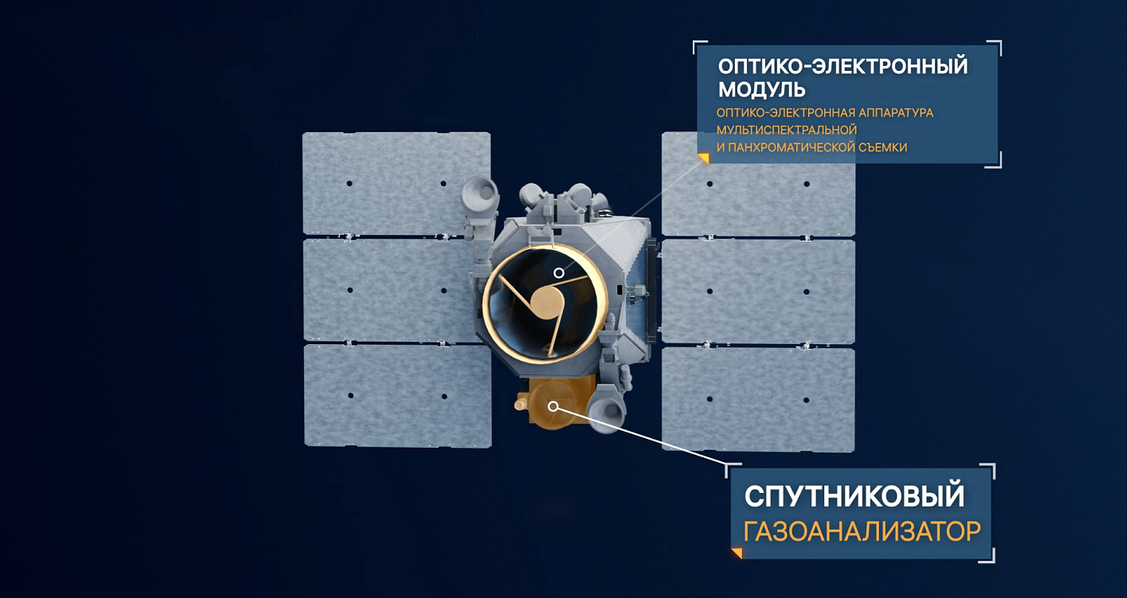
Six copies of Smotr-V will provide the ability to conduct optical panchromatic and multispectral surveys using optoelectronic equipment of at least 80,000 thousand km2 per year with a resolution of 0.5 meters per pixel in several modes. These are frame, corridor and area types of shooting and stereoscopic shooting.
With its help, it will be possible to monitor the condition and environmental monitoring of industrial facilities and adjacent areas, as well as hard-to-reach territories, including the Arctic.
Satellites of this group will also be equipped with gas analyzers. They will help to produce video spectral shooting of high spectral resolution of specified areas of the Earth's surface in the infrared range with reference to geospatial coordinates. Thus, Smotry-V will detect greenhouse gas emissions plus methane emissions from 250 kg/h.
Read materials on the topic:
Russia Can Speed Up Data Transfer From Satellites Hundreds of Times
Russian Starlink from Bureau 1440 Already Transmits Signals Between Satellites and to Earth
Russian Satellites Will Receive New Transponders from RKS
Kaliningrad Will Put the Production of Engines for Russian Satellites of the Sphere Project on the Conveyor Belt
Never miss our newsAdd this site to your preferred sources to see us more oftenAdd on Google

















