The Russian automatic interplanetary station Venera-D will collect samples to check for biomarkers of primitive life in the cloud layers and on the surface of the planet of the same name. This was announced by Lev Zeleny, scientific director of the Space Research Institute (IKI) of the Russian Academy of Sciences.
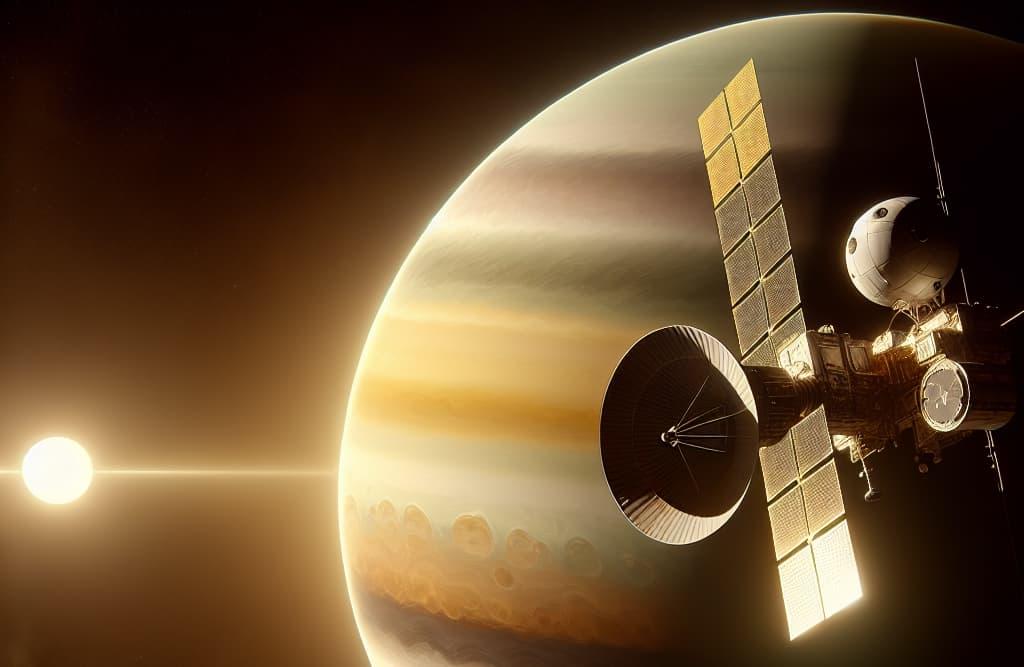
According to him, scientists will activate 2 balloons that will move at an altitude of about 50 km. Special instruments will record the content of certain substances in the gaseous medium.
There is also a second line of research — the search for life on the surface.
Scientists do not rule out the possibility of some forms of life on Venus. This opinion appeared in scientific circles after evaluating a series of shots taken by Soviet landing vehicles. They show indefinite structures located near the equipment. In different images, they change their position, the academician explained.
If we look at the issue more broadly, life is not necessarily something protein-based, resembling you and me.
About the Venera-D Mission
Zeleny recalled that Russian specialists are planning to launch a landing module, a balloon probe, and an orbital vehicle as part of the Venera-D mission by 2036. Engineers are now starting preliminary design. At this stage, it will be known whether it is possible to speed up the project by 2-3 years. The creation of an automatic interplanetary station is included in the national project for space exploration.
Read more materials on the topic:
- A giant cave was found under the red-hot crust of Venus - it will be studied by the Russian mission "Venera-D"
- Technologies of "Venera-9" half a century ago will form the basis of modern devices "Venera-D"
- Space in the long box: Russian missions to the Moon and Venus have been postponed
Never miss our newsAdd this site to your preferred sources to see us more oftenAdd on Google