The construction of the nuclear icebreaker "Leningrad" continues at the Baltic Shipyard of the United Shipbuilding Corporation (USC). The Project 22220 ship is 20% complete, with hull assembly and equipment installation underway.
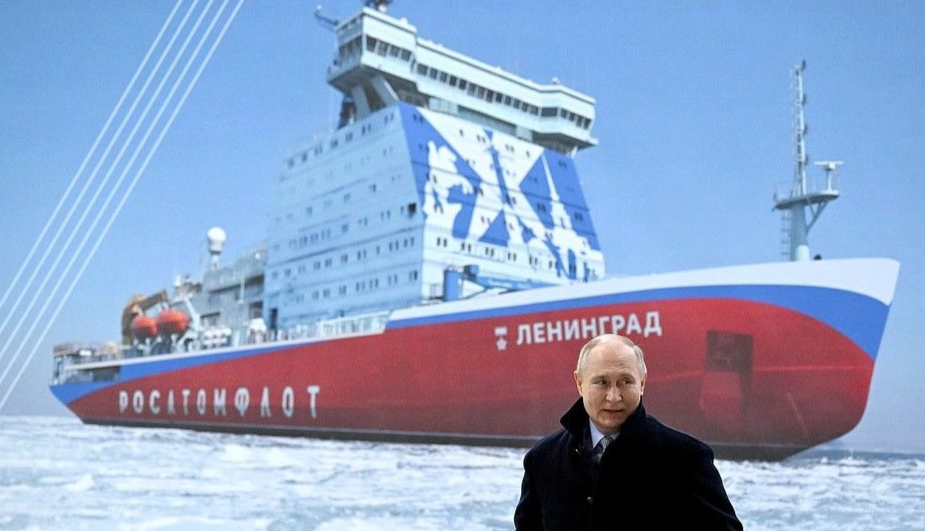
The largest and most powerful nuclear icebreaker "Leningrad" has reached 20% completion. This is the sixth vessel of Project 22220, which is being built at the Baltic Shipyard USC under the order of "Rosatom". Low-pressure steam generators have already been placed on board - they ensure the functioning of systems in harsh Arctic conditions. Currently, the formation of the nuclear vessel's hull continues.
Durable metal is cut even underwater. The elements prepared here are assembled in the adjacent workshop - from small flat parts to massive volumetric sections.
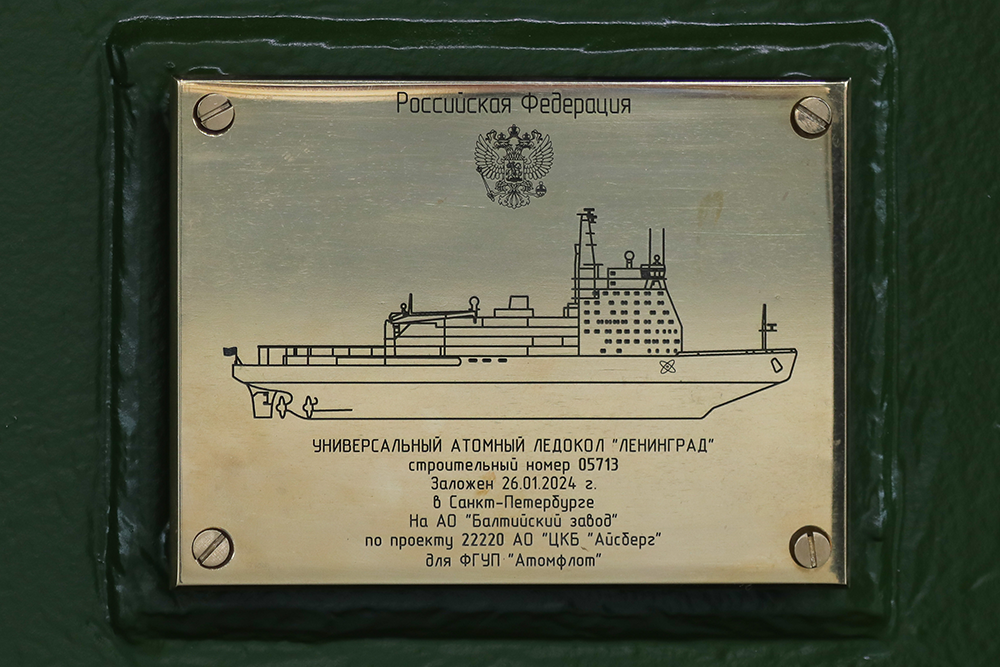
The bottom sections of the future icebreaker are about to be installed on the longest slipway in Russia, which is 350 meters long. It is possible to build huge nuclear ships here, similar to the vessels of Project 22220.
"Leningrad" is only just beginning to take shape as a vessel. The hull is being formed: its height is about five stories, and with the superstructure - like an eighteen-story building, that is, over 50 meters. The width is 34 meters, and the length is almost two football fields, or 173 meters.
Low-pressure steam generators have already been installed in the inaccessible compartments of the future ice giant. As soon as the hull assembly is completed, a nuclear reactor will start operating in "Leningrad". It will be two-chambered, with a capacity of 175 megawatts for each reactor. The icebreaker will be able to function autonomously for seven years - only the delivery of food and crew changes will be required.

We have loaded the protection tanks, and we are now forming biological protection blocks. Next, after completing these works, we will proceed to the installation of "Rhythm-200" reactors. These reactors are unique: they have increased power, compact size, and high reliability.
This is already the sixth icebreaker of Project 22220, designed to operate in the western sector of the Northern Sea Route. It is capable of overcoming ice up to three meters thick, paving the way for other vessels.
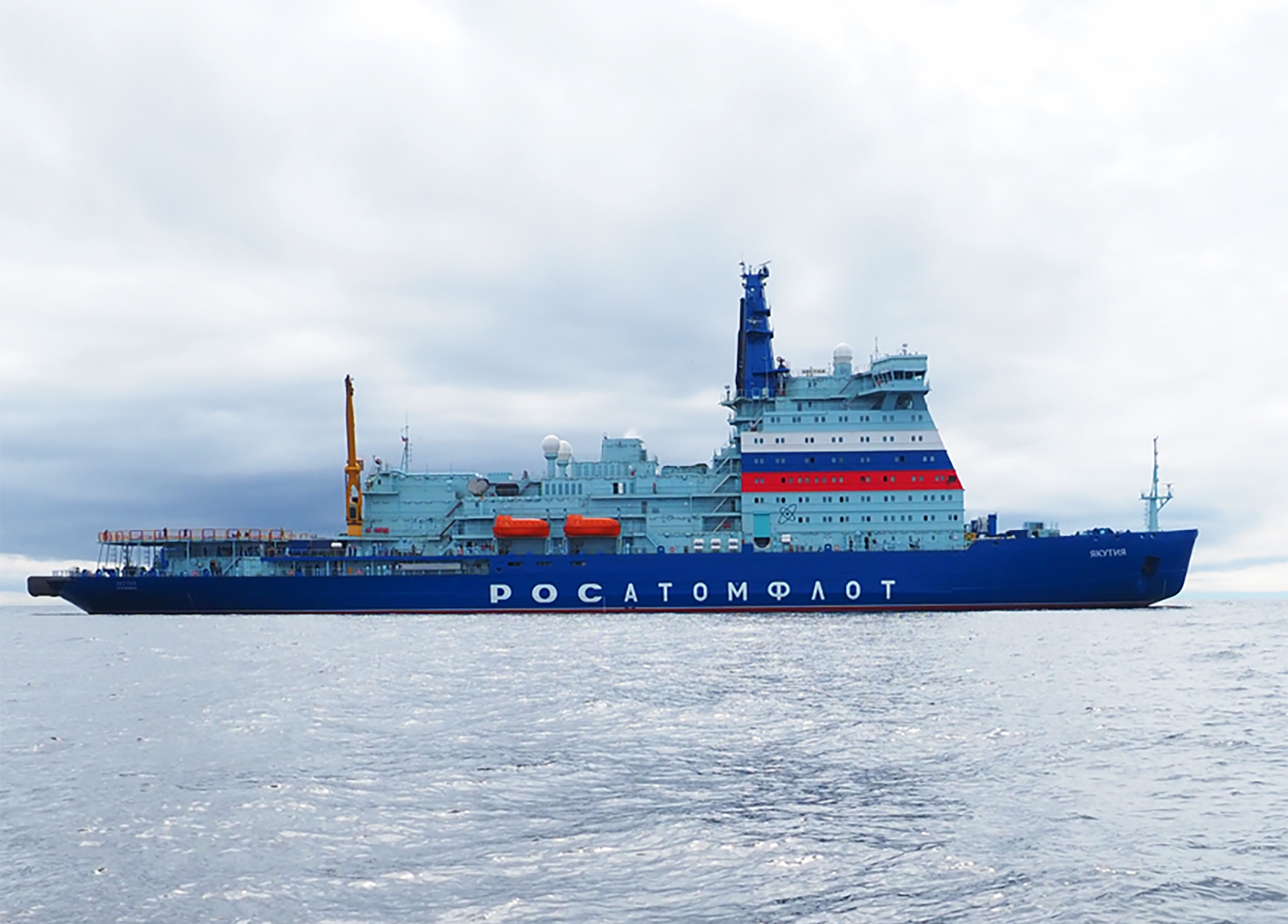
A key feature of the vessel is its dual-draft capability, which allows it to operate effectively both in the Kara Sea and in the Yenisei River estuary.
In 2028, the nuclear-powered ship should set off for the Arctic. Unlike its predecessors - the icebreakers "Chukotka" and "Yakutia" - "Leningrad" will receive a unique design: the superstructure will be decorated with silhouettes of the Bronze Horseman and the Peter and Paul Fortress in the light of spotlights - in memory of the dead residents and defenders of the city.
Technical characteristics:
- Displacement: smallest - 26 771 t, standard - 32 747 t, full along the waterline - 33 540 t.
- Length: greatest - 173.3 m, overall - 172.7 m, along the waterline - 160 m.
- Width: greatest - 34 m, along the waterline - 33 m.
- Height: side amidships - 15.2 m, greatest - 59.3 m.
- Draft: minimum operating - 9.03 m, full along the waterline - 10.5 m.
- Engines: 2 × РИТМ-200, power: thermal - 2 × 175 MW, electrical - 2 × 36.0 MW.
- Power: electrical - 72 MW (97 893 hp), on shafts - 60 MW (81 577 hp).
- Propulsion: 3 fixed-pitch propellers with 4 removable blades.
- Speed: full - 22 knots in clear water, 12 knots in 1.5 m ice, 2 knots in 2.8-2.9 m, 3 m ice (maximum ice thickness).
- Cruising range: unlimited.
- Endurance: 7 years (fuel reload), 6 months (food supplies).
- Crew: 53 people.
- Hull material: special alloy steel.
Earlier,www1.ru reported that Indian scientists will fly to the center of the earth for the first time on a Russian Il-76 aircraft.
Read more materials:
Now on home

Start of deliveries scheduled for 2027

Over 51,000 new motorcycles were sold in Russia in 2025

The car will take at least a year to assemble

The application's audience has reached 20 million users

The model will be included in the list of cars for taxis, price - from 2.25 million rubles

All parking lots of the "Administrator of the Moscow Parking Space" are connected to the service

The cars will be supplied to the Moscow Transport Service Directorate
Deliveries to India may begin in 2028
The technology provides automated search for all types of defects in power units
The plane flew 500 km, accelerating to 425 km/h

The plant stated that the information about the termination of purchases for models 6 and 8 is not true
Scientists are using the "Ekran-M" installation
Articles
-
Russian An-124 "Ruslan" Stuck in Canada for 4 Years and Accrues Millions in Fines
26 Jan 2026
-
Coaxial Propellers: How Counter-Rotation Increases Turboprop Engine Efficiency
25 Jan 2026
-
Kazan Aviation Plant Breaks Old System: Tu-214 to be Assembled Like Cars
25 Jan 2026
-
How Engineers and Technicians Are Paid Today in the Russian Aviation Industry: An Overview with Figures
24 Jan 2026