Translated with AI from the Russian original.
The mysterious Magnetar star (SGR 0501+4516) continues its journey through the Galaxy. Scientists still do not understand where this celestial object came from.
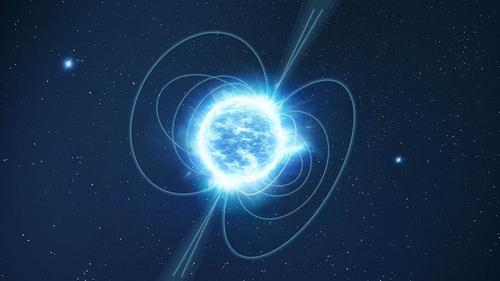
The Magnetar was first discovered at the NASA Swift Observatory in 2008. The star is one of 30 known magnetars in the Milky Way, but its behavior calls into question generally accepted theories about the origin of such celestial bodies.
SGR 0501+4516 is a neutron star with an exceptionally strong magnetic field, a trillion times more powerful than Earth's. It is called a "zombie star" and is believed to possess "sinister superpowers." The fact is that this is the remnant of a dead star that suddenly "rises" and continues to influence the surrounding space with its powerful magnetic field and bursts of radiation.
SGR 0501+4516 is now 15,000 light-years away from our planet, and a meeting with it does not threaten Earth in the next million years. However, scientists still cannot accurately explain its origin.
Initially, it was assumed that the Magnetar was formed as a result of a supernova explosion. But observations have shown that it is not associated with a known explosion.
Researchers are considering two main versions of its appearance. This may be the result of a collision of two neutron stars or a scenario in which a white dwarf absorbs material from a companion star, turning into a magnetar. SGR 0501+4516 remains a mystery that has yet to be solved.
Earlier www1.ru reported that scientists of the SAO RAS studied the unique dying blue star DDO68-V1 with low metallicity.
Read materials on the topic:
Scientists: The Earth is threatened by a solar superflare capable of throwing humanity back into the Stone Age
Russian scientists have proven the "ordinariness" of the Solar System
The mystery of the formation of fast-flying neutron stars was revealed in Moscow
Never miss our newsAdd this site to your preferred sources to see us more oftenAdd on Google

















