Scientists from ITMO, Skoltech, and HSE University have created the world's first perovskite laser that operates directly from electric current. Unlike conventional lasers, which require external illumination – another laser or a powerful lamp – to operate, the new development connects to a current source like a regular LED.
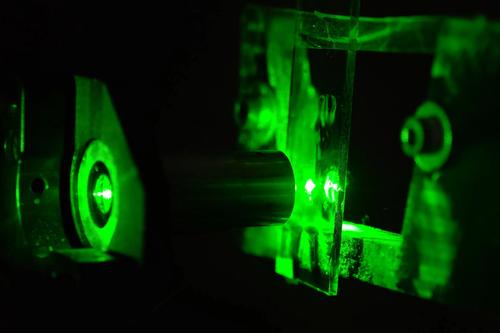
The key problem solved by the scientists was the destruction of perovskite crystals under current due to overheating and contact with metal electrodes. The team replaced metal electrodes with single-walled carbon nanotubes – this material does not destructively interact with perovskite and dissipates heat better.
The active element of the laser – a perovskite plate microcrystal – was grown directly from a chemical solution using controlled crystallization. This is significantly simpler and cheaper than traditional layer-by-layer deposition of materials in vacuum chambers. The grown crystal was placed between two Bragg mirrors, which trap light within the structure, causing it to pass repeatedly through the perovskite and amplify before exiting.
During laboratory tests, the laser generation threshold was reached at a constant current of only 60 microamperes. Prior to this experiment, direct electrical excitation of a perovskite laser remained an unsolved problem in the global scientific community.
Currently, the device only operates at an extremely low temperature of about –265 °C, which limits its practical application. Researchers plan to achieve stable operation at room temperature – this requires improving heat dissipation from the crystal and increasing material stability. In the future, such lasers could be placed directly on microchips and used in portable electronics, optical sensors, and quantum devices.
Read more on the topic:
Never miss our newsAdd this site to your preferred sources to see us more oftenAdd on Google