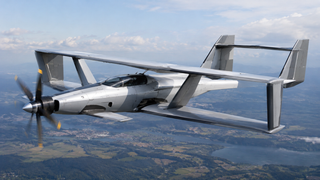
An engineer from St. Petersburg has registered a patent for an ornithopter wing that changes its configuration depending on the direction of the stroke. The author, Alexander Danilov, proposed equipping the movable flaps with magnetic strips: they should help form a continuous surface when the wing moves down and hold it during gliding.
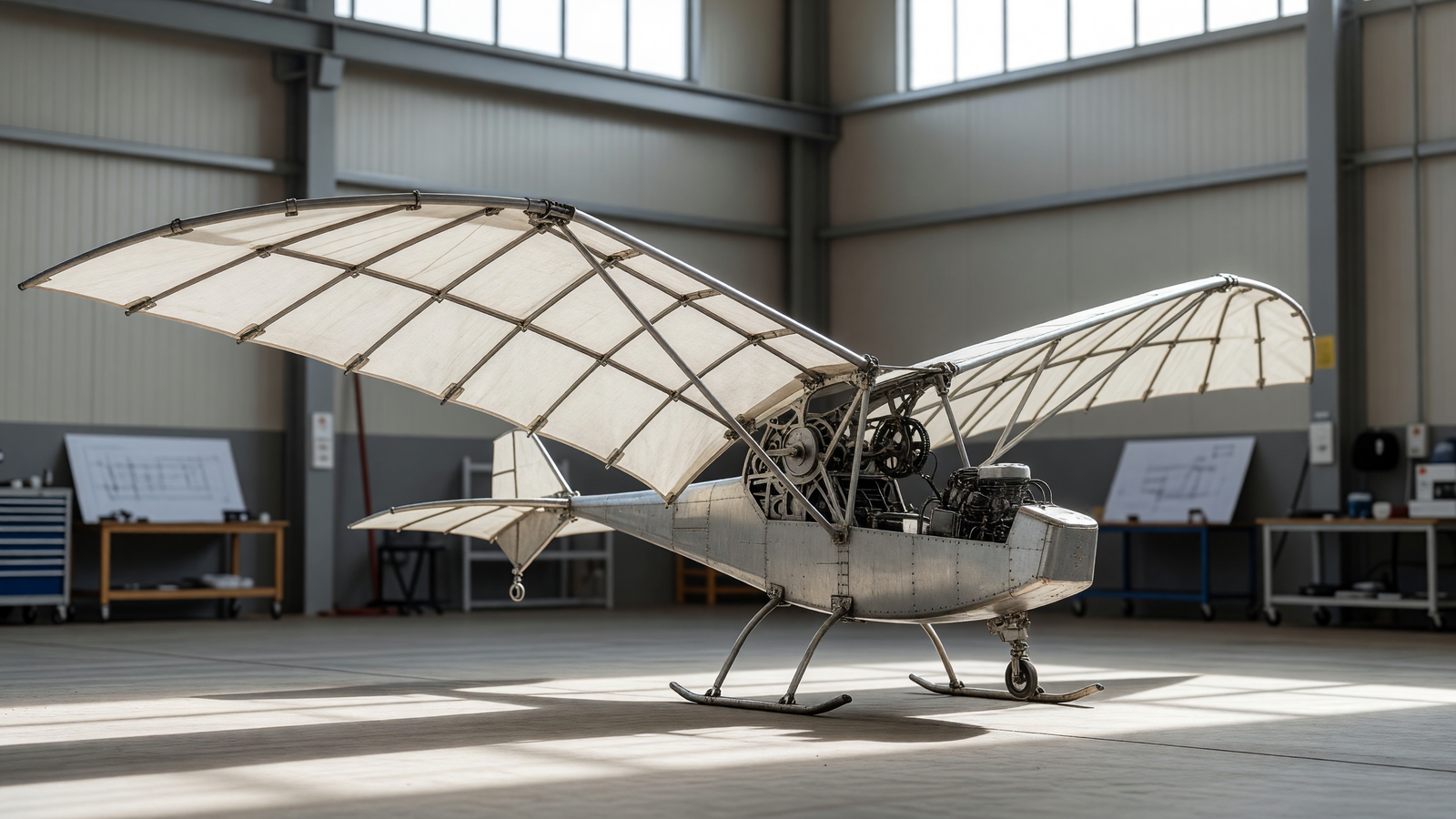
The design provides for two flapping wings, an engine, and a drive, and its main feature lies in the arrangement of the transverse sections of the lifting surface.
When the wing moves up, the flaps rotate approximately 90°, opening a passage for air and reducing resistance. On the return stroke, the airflow returns them to the wing's plane. Magnetic strips should attract adjacent elements and help them remain closed.
To prevent chaotic movement, rotation limiters are provided. According to the author's idea, they should ensure coordinated opening and closing of the sections, and magnetic coupling should increase the stability of their position during gliding. A separate drive for each flap is not required in this scheme.
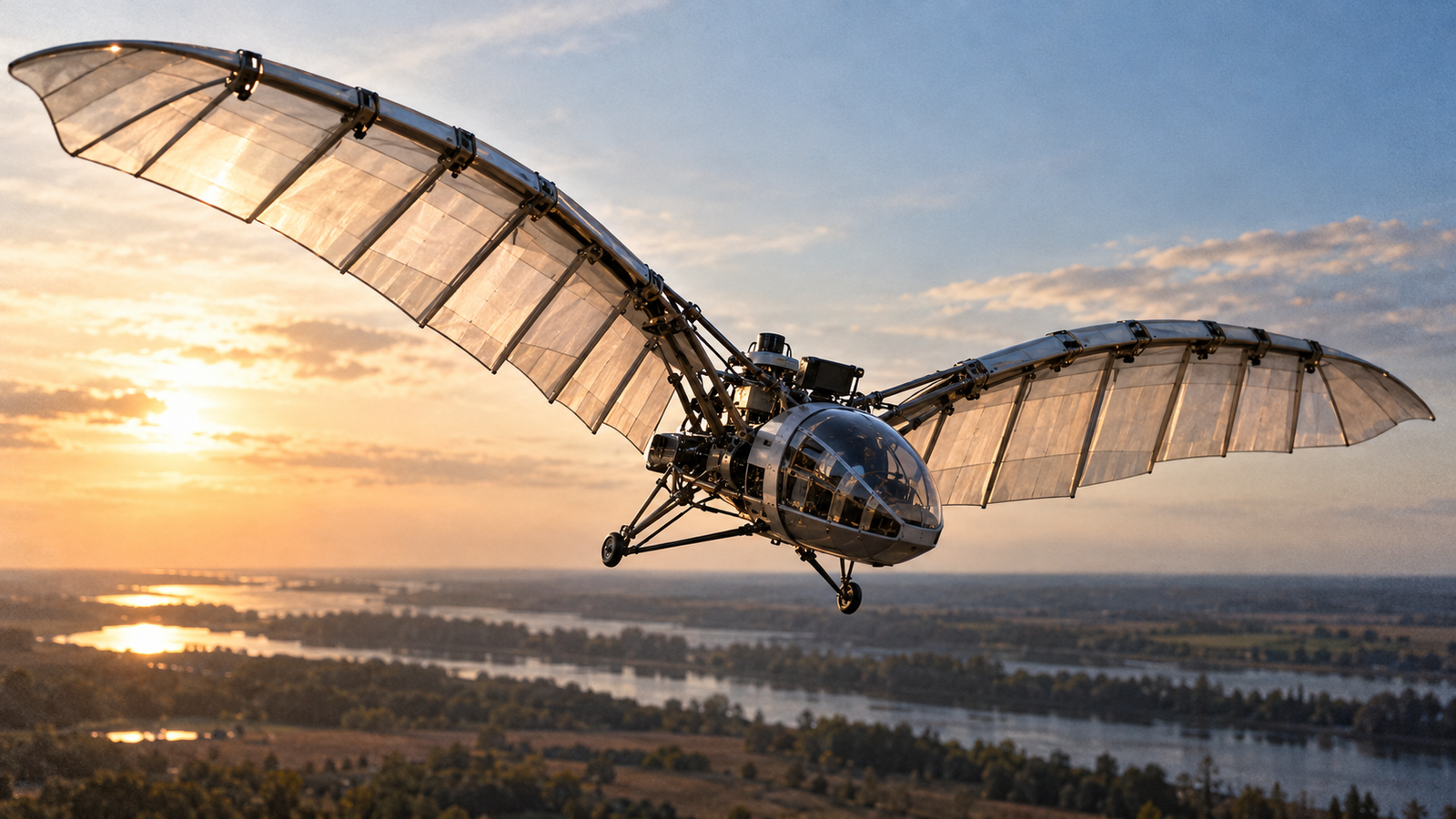
The patent description provides several calculated variants of the apparatus. For a manned ornithopter weighing about 200 kg, the wing area is 25 m², the wingspan is 15 m, and the power source is 3 kW. The estimated cruising speed is 10 m/s, or 36 km/h. For a larger version weighing about 400 kg, the author gives a wing area of 50 m², a wingspan of 25 m, and a speed of 20 m/s.
An unmanned version weighing about 5 kg with wings of 1.5 m² area and a wingspan of 2 m is also provided. For it, the power source is 0.5 kW and the estimated speed is 15 m/s, or 54 km/h.
The main declared feature of the design is the combination of freely opening sections on the upstroke with magnetic retention of a continuous surface on the downstroke.
Read more on the topic:
Never miss our newsAdd this site to your preferred sources to see us more oftenAdd on Google