The Luch Multifunctional Space Relay System (MKSR) (operator — Satellite System Gonets, part of Roscosmos) provided communication with the Progress MS-33 cargo ship at all stages of the flight — from launch to docking. The Soyuz-2.1a launch vehicle was launched from the 31st site of Baikonur on March 22, 2026, at 14:59 Moscow time. Docking with the Poisk module of the Russian segment of the ISS took place on March 24 at 16:41 Moscow time. At the moment the ship left the radio visibility zone of ground stations, the Luch system took over control and telemetry. Two spacecraft, Luch-5A and Luch-5B, were used to organize relay channels, and 17 communication sessions were conducted.
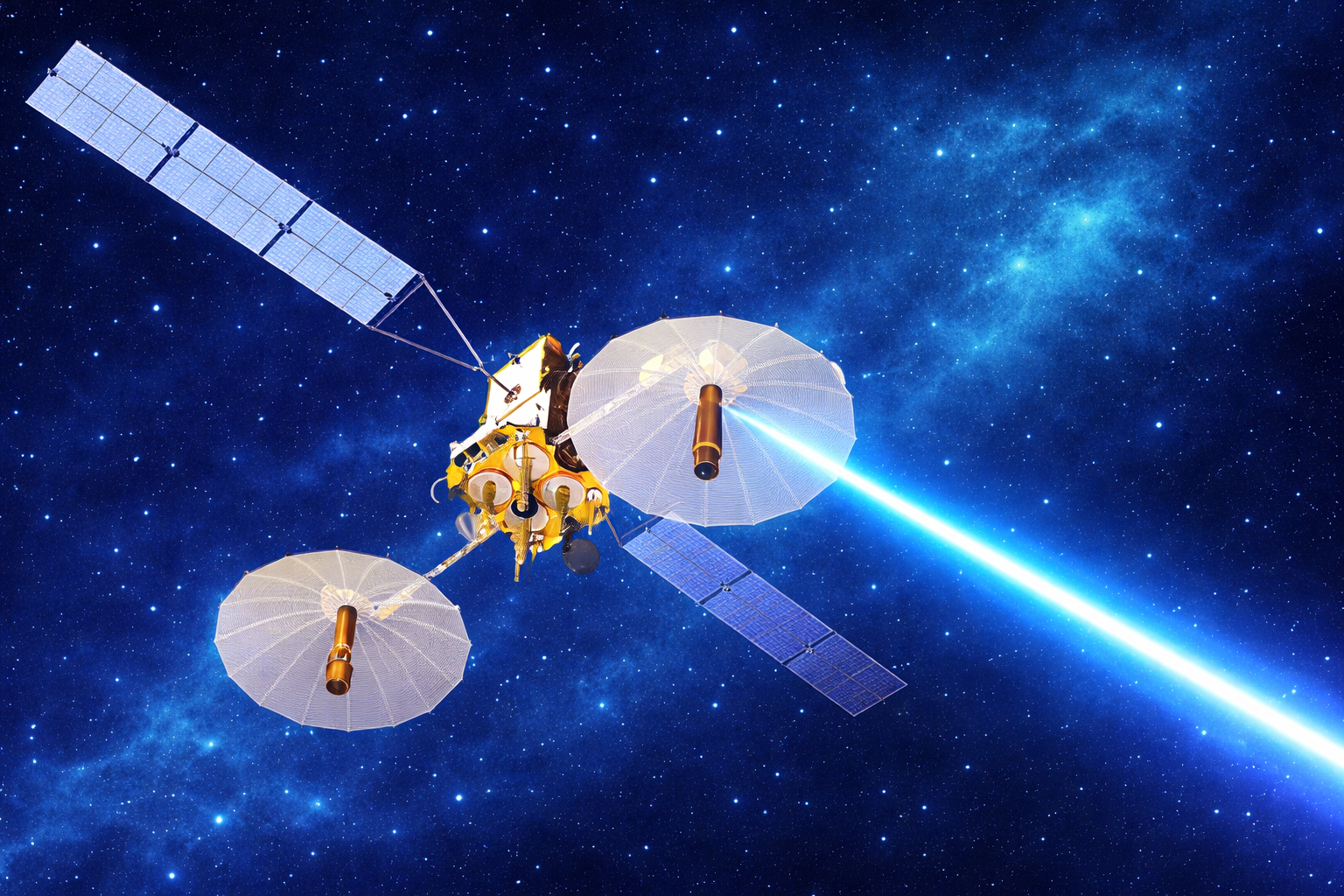
Luch Satellites and 17 Relay Sessions
After the launch of Progress MS-33, ground tracking facilities lost direct radio contact with the ship. Further control and telemetry reception were carried out through the geostationary relay satellites Luch-5A and Luch-5B, which received the signal from the board and transmitted it to the Mission Control Center (MCC) of the Russian segment of the ISS. Control commands were transmitted in the opposite direction through the same channels. In total, 17 relay sessions were conducted during the flight and docking, which allowed dispatchers to continuously monitor the ship's parameters even in the invisible section of the orbit.
Technical characteristics of the Luch MKSR:
- Composition: 3 satellites in geostationary orbit (Luch-5A, Luch-5B, Luch-5V)
- Frequency range: C‑band (reception), Ku‑band (transmission)
- Data transfer rate: up to 150 Mbit/s per line
- Coverage area of one satellite: up to 60% of the Earth's surface
- Target task: retransmission of telemetry, commands, television from low-orbit objects
The role of the "Luch" system in the Russian segment of the ISS
The Luch system has been operating since 2015 and is an analogue of the American TDRSS (Tracking and Data Relay Satellite System). It reduces dependence on ground measuring stations and provides communication with manned and cargo ships for 80–90% of the orbit, including blind spots where the radio signal does not reach Earth. For Progress MS-33, the use of retransmission has become a standard element of the flight mission.
The launch was timed to coincide with the 65th anniversary of the first human flight into space — the launch vehicle was decorated with the corresponding symbols. The ship delivered more than 2.5 tons of cargo to the ISS: fuel for refueling, drinking water, oxygen, food containers, equipment for scientific experiments and station maintenance equipment. The Luch system will continue to provide communication with the ship during its unloading and subsequent undocking.
For Roscosmos, the routine operation of the retransmission system means a transition to continuous control of low-orbit spacecraft without pauses for flying over ground stations. 17 communication sessions with Progress MS-33 confirmed the reliability of the Luch group: two geostationary satellites can cover the ISS orbit along its entire length. In the future, the system will be used to provide communication with the Russian Orbital Station (ROS) and advanced manned spacecraft.
Read more materials on the topic:
- Cargo ship "Progress MS-33" successfully docked with the ISS manually
- Malfunction in orbit: "Progress MS-33" will be docked to the ISS manually
- "Soyuz" with "Progress MS-33" launched from Baikonur to the ISS with a cargo of 2500 kg
Never miss our newsAdd this site to your preferred sources to see us more oftenAdd on Google