At the National Research Nuclear University MEPhI, a team of young scientists has completed the creation of a Multi-Purpose Muon Detector (MDM), a large-scale installation for studying ultra-high energy cosmic rays.
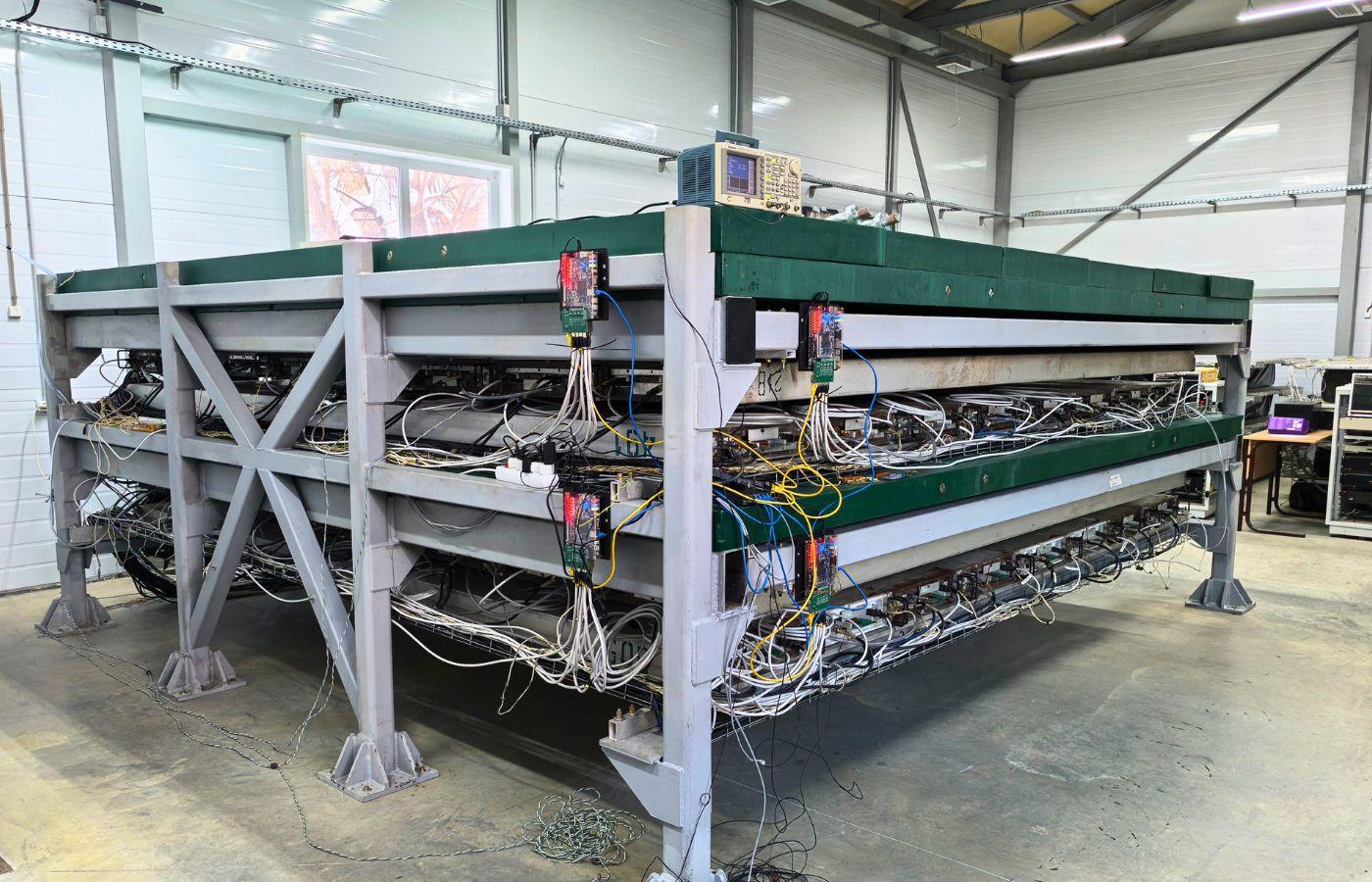
The detector has already been put into operation in the NEVOD experimental complex and works in conjunction with other installations of the complex, including a Cherenkov water detector with a volume of 2000 m³ and the world's largest coordinate muon detector TREK, representatives of MEPhI reported.
The MDM weighs more than 50 tons and consists of 32 multi-wire drift chambers, forming two coordinate planes of 13 m² each. To protect against background noise, the chambers are shielded with a 31.5 cm thick steel absorber. A comprehensive recording system is installed with time-to-digital converters, amplifiers for weak signals, synchronization systems, and preliminary data processing.
The main function of the detector is to register muons, secondary particles that occur when cosmic rays collide with the Earth's atmosphere. These rays have energies hundreds of millions of times higher than particles accelerated in the Large Hadron Collider at CERN. Muons form extensive atmospheric showers, the study of which allows physicists to investigate fundamental processes of matter, including the formation of quark-gluon plasma, which is inaccessible on man-made accelerators.
In addition to fundamental science, the MDM performs applied tasks: the analysis of muon fluxes provides information about the state of the Earth's atmosphere in real time, and the high accuracy of the installation allows it to be used as a reference stand for calibrating other elementary particle detectors.
As noted in MEPhI, 73% of the project participants are young scientists, and the installation opens up opportunities for further research of cosmic rays and the development of domestic experimental physics.
Read related materials:
- Will increase the accuracy of estimating mineral reserves: Rosatom has developed a new muon tomograph
- Scientists set a new record for measuring the magnetic moment of a muon: the experiment may change ideas about particle physics
- Orbital magnetic sensors on the Ionosphere-M satellites have passed successful tests
Never miss our newsAdd this site to your preferred sources to see us more oftenAdd on Google