Translated with AI from the Russian original.
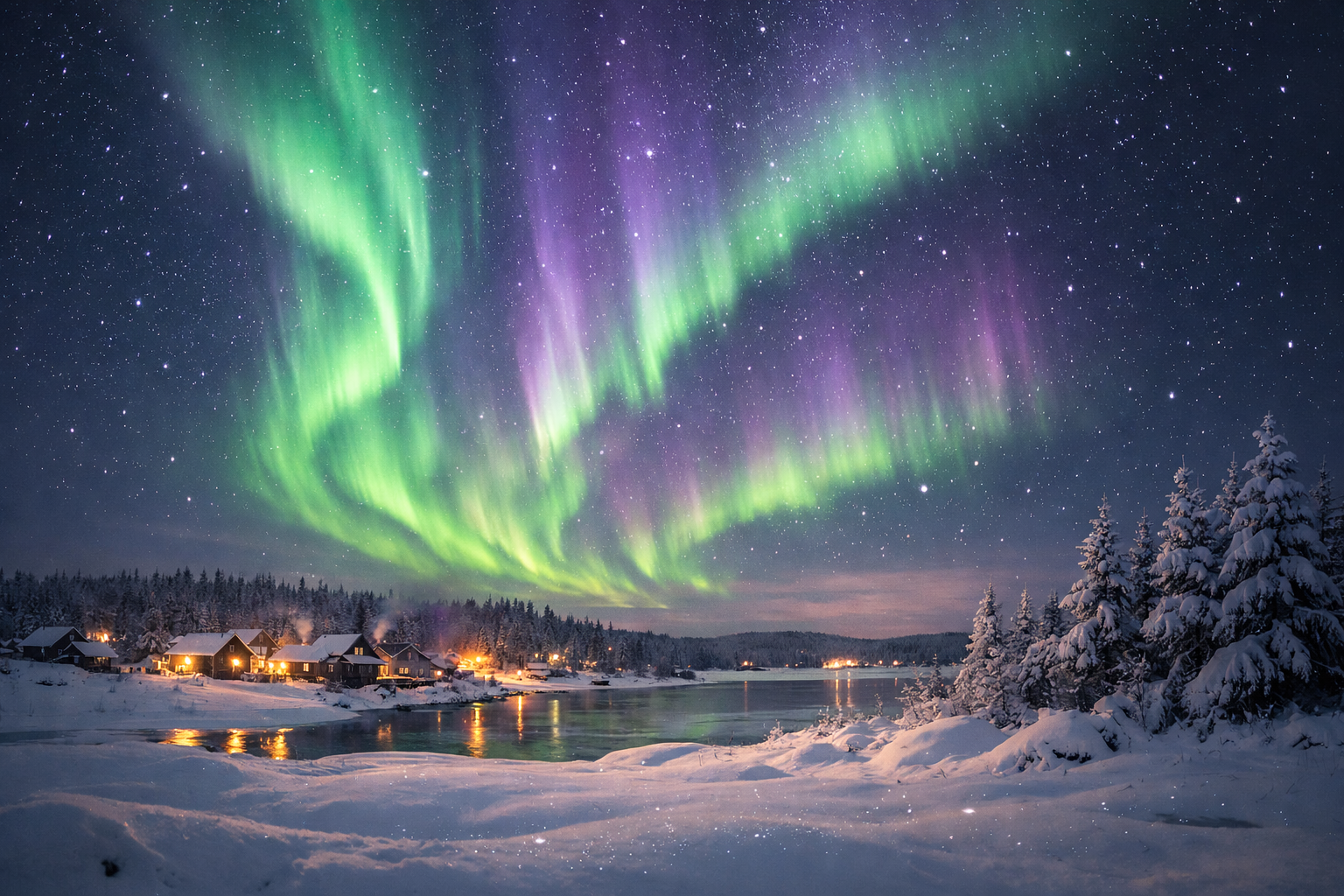
Scientists from the Solar Astronomy Laboratory of the Institute of Space Research of the Russian Academy of Sciences reported that strong solar flares that occurred on Monday night could cause auroras on New Year's Eve. The highest probability of observing auroras is expected in the Murmansk, Arkhangelsk, and Leningrad regions, as well as in Karelia.
Experts noted that the Sun has been showing increased activity in recent days, but almost all flares occurred in areas distant from the "Sun - Earth" line. The only zone capable of influencing space weather was area 4317 in the northern hemisphere of the star, where a series of flares were recorded on the night of December 29, including two powerful category M flares - at 01:39 (level M4.2) and at 03:02 Moscow time (level M2.2).
According to modeling results, a cloud of plasma of medium power was ejected into space as a result of these events. Scientists believe that it may reach Earth on the edge on the night of December 31 to January 1. The exact time is predicted with an error of up to five to seven hours.
The most favorable conditions for observing the northern lights are expected in the northwest of Russia - in Murmansk, Arkhangelsk, St. Petersburg, and Karelia. For the central regions of the country, the probability of auroras remains low, as the flare was of medium strength and partially displaced relative to Earth.
The laboratory noted that, against all odds, the Sun presented an unexpected surprise for the holidays, creating "intrigue for the New Year": if the chances of seeing the northern lights were minimal the day before, now they have increased significantly. Scientists suggested that on New Year's Eve, the Sun itself might even "perform a miracle", giving the residents of Russia a rare astronomical spectacle.
Read more on this topic:
- Magnetic storms are expected during the New Year holidays: three class M flares occurred on the Sun overnight
- No surprises from space: no magnetic storms until the beginning of 2026
- Pre-New Year's fireworks: a powerful flare occurred on the Sun on December 27
Never miss our newsAdd this site to your preferred sources to see us more oftenAdd on Google

















