Translated with AI from the Russian original.
Specialists from the Samara National Research University named after Academician S.P. Korolev have developed a new method for combating space debris. It is based on mathematical modeling of the process of "blowing" debris from orbit using an ion beam. The results are published in the journal Vestnik St. Petersburg University, Mathematics.
According to researchers, even tiny particles of debris can pose a danger to satellites and the International Space Station. Larger objects - rocket fragments or old satellites - can lead to catastrophic damage. Today, there are tens of thousands of pieces of debris in near-Earth orbit, and their number continues to grow.
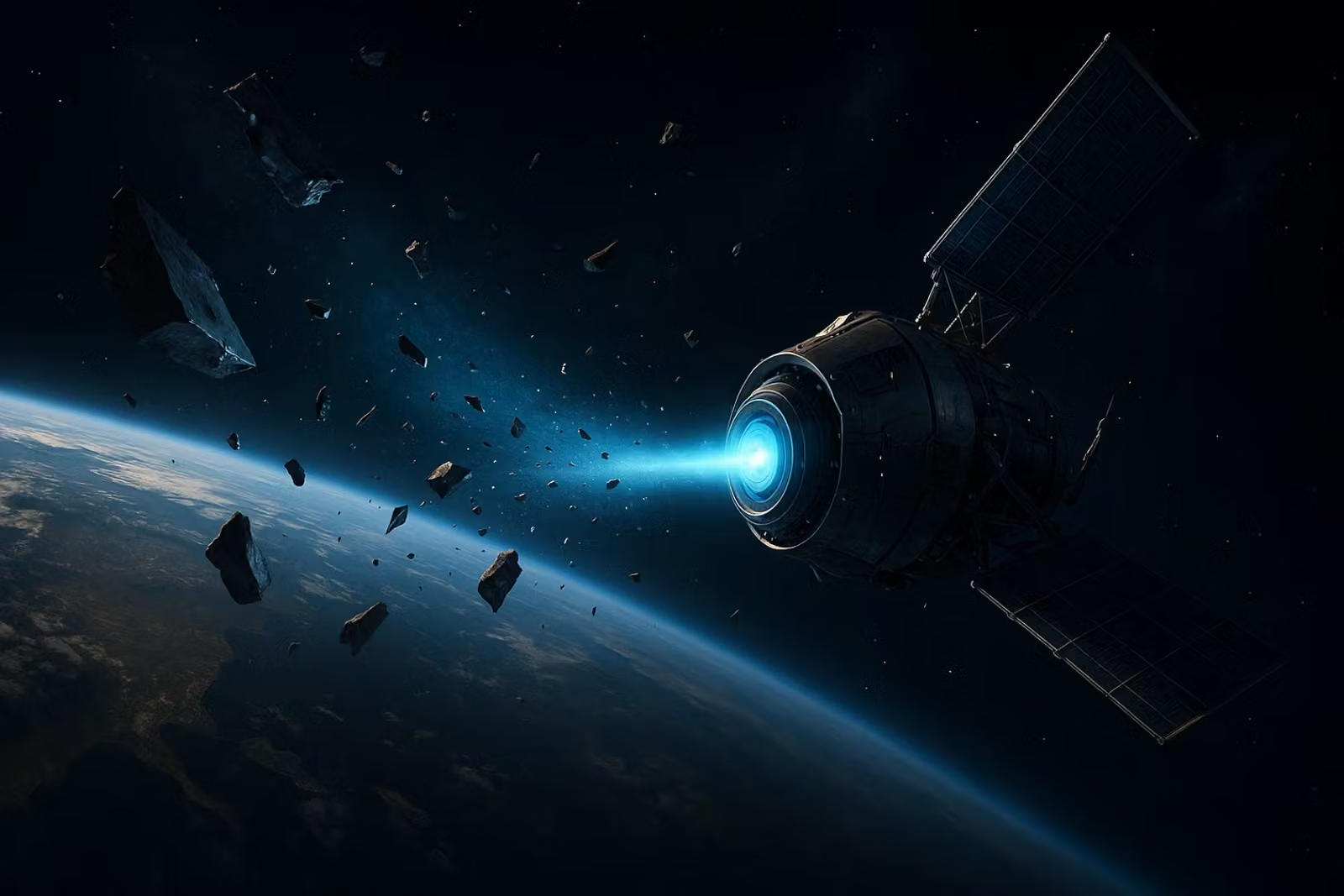
The new technology involves the use of a space "cleaner" that directs an ion flow onto the debris object. The particles of the jet crash into the surface of the debris, creating a small force. This force is enough to gradually change the trajectory of the object and remove it from orbit. "In fact, we are blowing the debris with a torch of an electric propulsion engine, and it slows down, leaving its orbit," explained Alexander Ledkov, Associate Professor of the Department of Theoretical Mechanics at Samara University.
The main difficulty of the method lies in the fact that the created force is extremely small - only hundredths of a newton. The process of removing debris can take months, which requires complex and lengthy calculations. To reduce the load, scientists have developed a simplified mathematical model. It is based on Gauss's equations and the Volosov averaging method and allows calculating debris trajectories faster and without loss of accuracy. The effect is especially noticeable when analyzing rotating objects, where standard methods require huge resources.
Space debris is one of the most serious threats to space exploration. Every year, the risk of collision of operating satellites with debris increases. Solving this problem is critical for the safety of space flights, the stable operation of navigation and telecommunication systems, on which modern life depends.
Read more materials on the topic:
- Scientists from LETI have developed a space debris control system
- Speed - 12 km per second: RSC Energia spoke about the space enemies of the ISS
- Samara proposed to "blow away" space debris to protect the ISS
Never miss our newsAdd this site to your preferred sources to see us more oftenAdd on Google

















