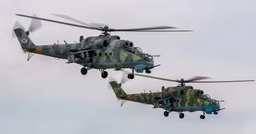
An easy way to protect enterprises and oil refineries from drones could be Mi-24 and Mi-8 helicopters, of which "hundreds are in storage." This proposal was made by military pilot and aviation expert Alexey Voevoda.
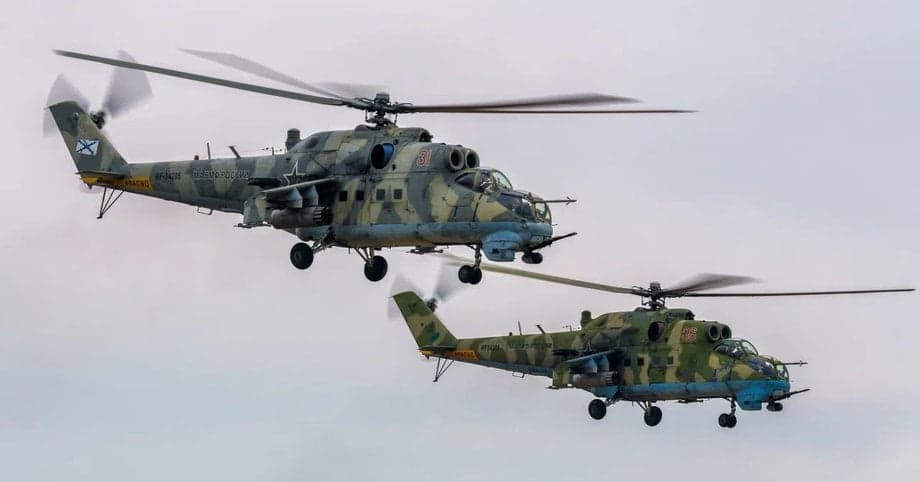
According to him, the Aerospace Forces (VKS) are actively re-equipping brigades from Mi-24 to Mi-28. Forming another brigade and regiment on Mi-24 would help close the sky.
The country has hundreds, I repeat, hundreds of Mi-8s, which can also be used to hunt drones. There are plenty of abandoned airfields in the center of the country. No joke. Any of our regions can "boast" a couple of abandoned spots.
Mi-24 characteristics:
- Crew - 2-3 people
- Cruising speed - 250 km/h
- Maximum speed in horizontal flight: - up to 407 km/h
- Practical flight range - 450 km
- Average fuel consumption - 780 l/hour
- Dynamic ceiling - 4950 m
The unofficial name of the Mi-24 is "Crocodile." Its production was established in the 1970s, and the helicopter is still being produced.
Earlier www1.ru reported that Russia is building the world's largest electronic intelligence complex near Kaliningrad.
Read more materials:
Russian military staged a tank ballet for Mongolian colleagues: video
"Uralvagonzavod" announced the uniqueness of "Solntsepek": when there are really no analogues
Now on home
The new "sleeve" can withstand temperatures from -50 to +50 °C and is fully import-substituted
The updated program envisages a 5% reduction in production, but is extended by five years

Improved 3400 hp engines ensure the efficiency of freight locomotives
Kalashnikov's Development is Effective at Any Time of Day
Designers ensure mass production while maintaining technological sovereignty
Analyst Korotchenko stated that the chassis from the Yars is used for the MRBM

Deputy Prime Minister Yuri Trutnev revealed details of a large-scale plan for the development of the Arctic transport infrastructure

Rosatom supplies nuclear fuel and is building another nuclear power plant in Europe
The recording was taken through the lens of the "Sosna-U" sight
"ODK-Klimov" Filed Seven Lawsuits Against KVZ
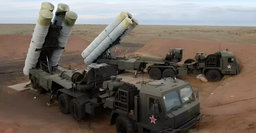
The system is capable of becoming the basis for deploying air defense over the country
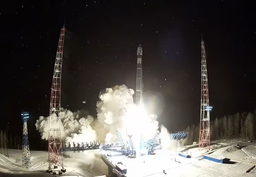
The launch was carried out from the Plesetsk cosmodrome