Researchers at Perm Polytechnic University (PNRPU) have developed a comprehensive mathematical model that predicts the behavior of impurities under different smelting conditions.
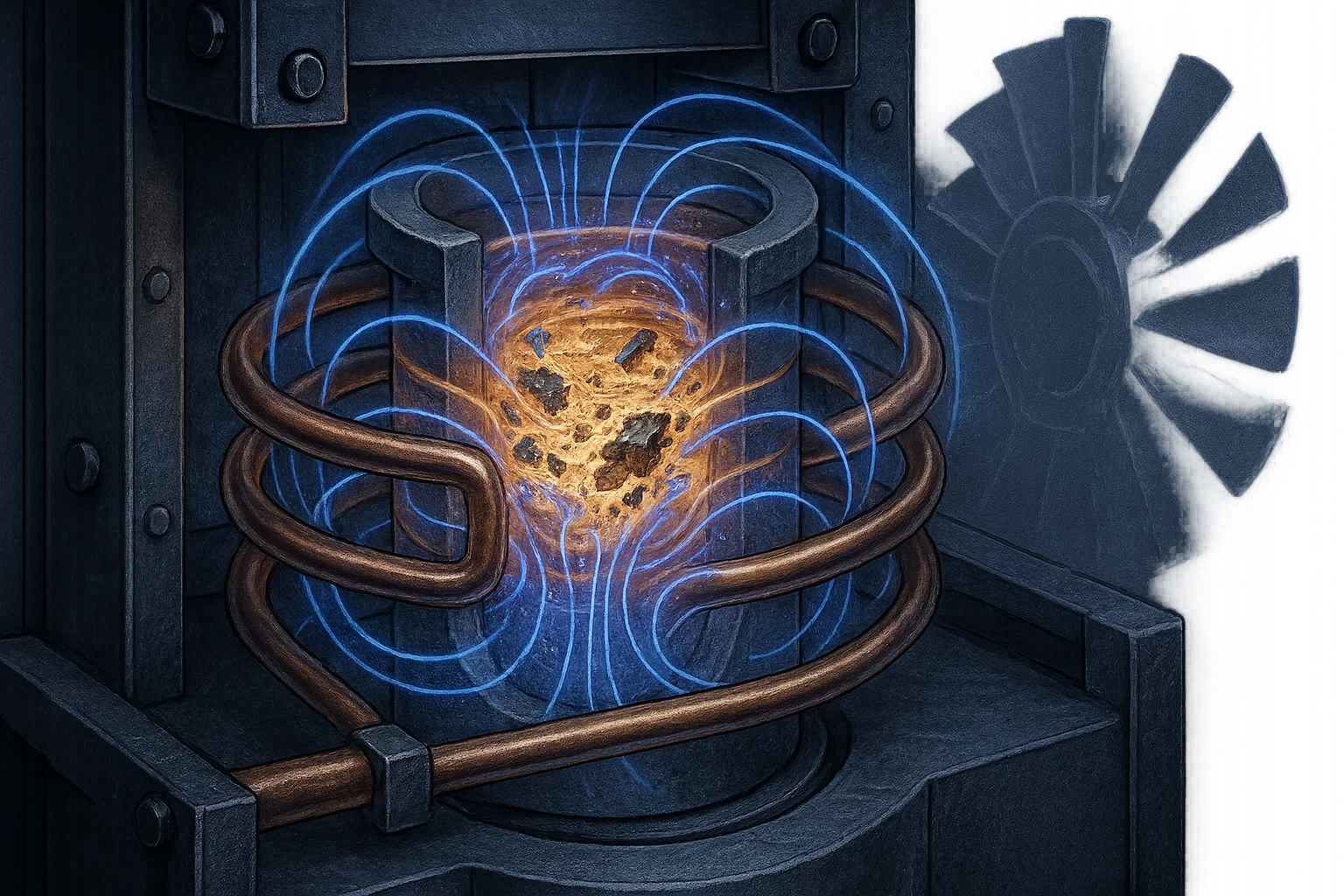
The model analyzes the influence of the magnetic field, heat transfer, and simultaneously considers the state of the film on the surface and the movement of the metal, which was not previously taken into account in industry methods. Computational experiments with the nickel alloy ЧС-70 ВИ showed that at frequencies up to 240 Hz, the magnetic field penetrates deeper into the metal, enhancing mixing. This creates stresses in the oxide film, tearing it before it gets into the casting.
Professor Illarion Nikulin explains:
We found out which smelting modes should be used to accelerate this film at the smelting stage. It turned out that its behavior depends on the frequency and intensity of the magnetic field. It penetrates deeper into the metal at low frequencies: up to 240 Hz for the nickel alloy ЧС-70 ВИ, which is designed for operation at high temperatures and is widely used in aircraft and rocket engineering, and a crucible radius of 10 cm. This leads to more intensive mixing and greater stresses in the film, which cause it to rupture and be removed from the surface. This means that smelting in this mode will minimize defects and rejects in finished products.
In the aviation and space industries, up to 10% of cast components are rejected due to hidden defects caused by oxide films during metal remelting. Induction heating technology, while ensuring metal purity, faces the problem of contamination from secondary raw materials, which are used for cost savings.
The research results arepublished in the "Journal of Engineering Physics and Thermophysics". The work of scientists was carried out within the framework of the "Priority-2030" program.
Read more materials on the topic:
It became known how many composite parts were used in the domestic aircraft engine PD-14
Software from Perm scientists will speed up the testing of gas turbine engines by 1.5 times











