Russian researchers have made a significant breakthrough in the field of autonomous navigation by developing PRISM-TopoMap technology. This method, created through the joint efforts of specialists from the Moscow Institute of Physics and Technology, the Federal Research Center "Informatics and Management" of the Russian Academy of Sciences, and the AIRI Research Institute, fundamentally changes the approach to robot orientation in space.
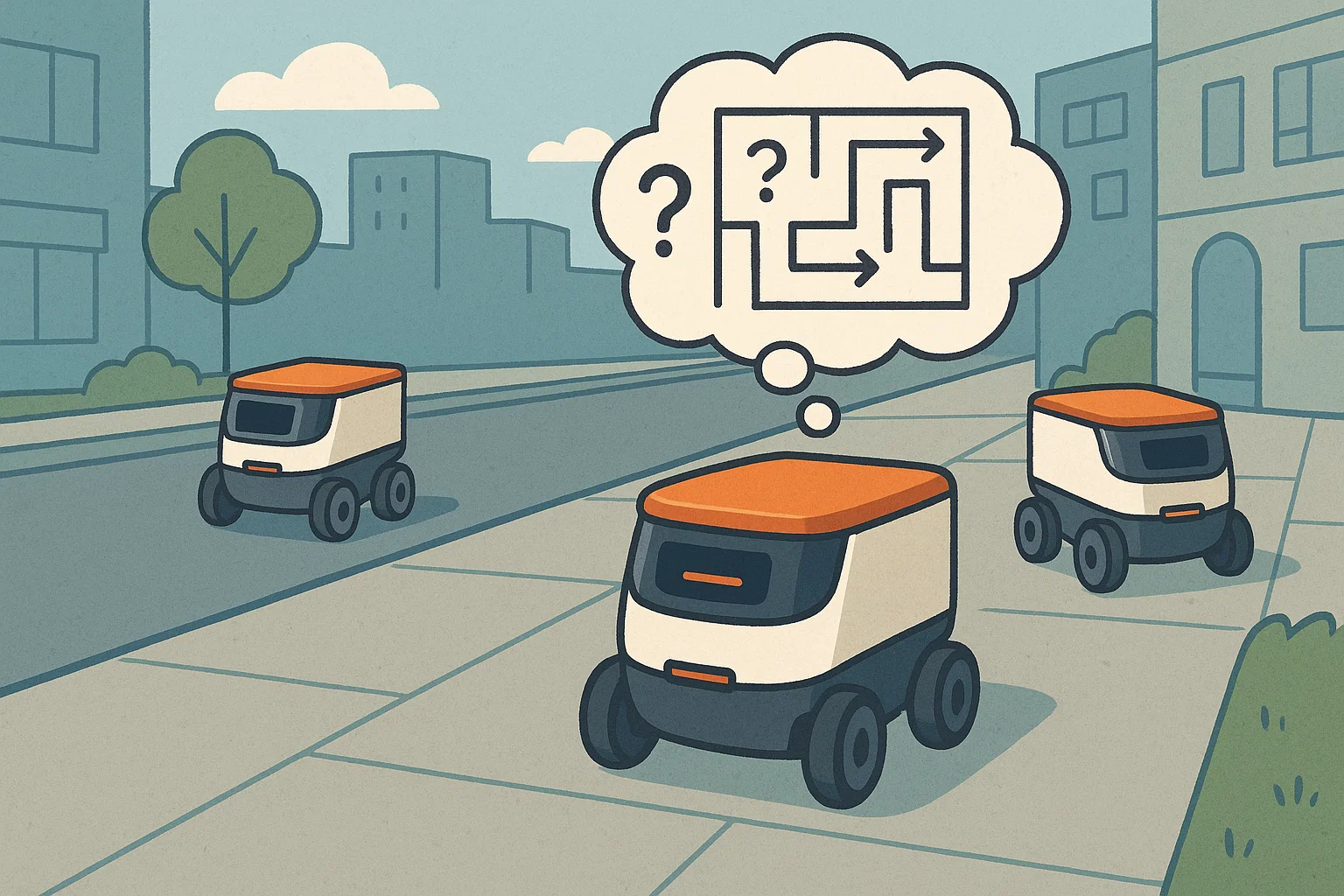
The essence of the new technology lies in imitating the principles of human memory. Instead of the traditional approach for robotics, which requires building detailed metric maps or relying on signals from global navigation systems, PRISM-TopoMap allows machines to memorize key landmarks and the relationships between them.
It's similar to how a person remembers a new place. We don't memorize every detail, but we highlight the main landmarks and the connections between them. This principle underlies the technology called PRISM-TopoMap, making it a practical solution for autonomous robot navigation in real-world conditions.
The technical implementation of the method combines several modern data processing technologies. The algorithm analyzes information coming from cameras and lidars, using advanced methods of pattern recognition. This allows the robot to identify locations even when the lighting or viewing angle changes. Before adding a new point to the map, the system conducts a thorough comparison with already known data, forming a topological diagram in the form of a graph - a mathematical abstraction where nodes represent key points, and links represent routes between them.
The effectiveness of PRISM-TopoMap was confirmed during a series of tests. Scientists conducted testing in five different virtual 3D environments, as well as on a real wheeled robot.
Our experiments in virtual 3D environments and tests on a real robot have shown that the new method successfully builds accurate and connected map diagrams even in the presence of sensor measurement errors. It not only provides complete coverage of the space, but also works significantly faster, cheaper, and more efficiently than existing analogues.
The prospects for applying the technology are extremely broad. In the logistics sector, it will allow autonomous couriers to work effectively inside buildings where GPS signals are unavailable. For cleaning robots, the method means the ability to quickly adapt to changing environments.
Of particular interest is the use of the development in the space industry - for navigating rovers on other planets, where traditional positioning systems are unavailable.
The maps built by our method allow routes of up to several kilometers to be laid very quickly and easily.
Currently, developers are focused on improving the system. Work is underway to train algorithms to recognize types of premises - distinguishing kitchens, corridors, warehouses. In parallel, mechanisms for routing along the created schemes are being improved.
Read more on the topic:
Artificial intelligence storms Russian business: 45% of companies are already using new technologies
Made by AI: labeling of products generated by neural networks has been proposed in Russia