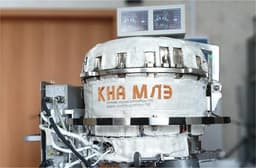
At the "Priborium" forum in Novosibirsk, the company "Motiv NT" announced the third generation of neuromorphic processors "Altai-3", designed for artificial intelligence tasks. The development, which started in the late 2010s with the support of "Kaspersky Lab", is entering the commercial stage: the first samples will appear in 2026.
Unlike the classic von Neumann architecture, "Altai" mimics the human brain, using spiking neural networks. This provides parallel computing, energy efficiency, and scalability.
The "Altai-1" processor, measuring 9×9 mm, created using the 28-nm process technology, consumes only 70 mW with 16 cores. Modules for data centers have been developed on its basis: a neuromorphic accelerator (8 chips), backplanes for 16 and 128 processors.
In tests, "Altai-1" outperformed Nvidia video cards: in computer vision tasks, it turned out to be 185 times more energy efficient than the GTX 1650 Ti and 13 times more efficient than the RTX 3080 Ti. When processing acoustic data in collaboration with the Kurchatov Institute, the chip also showed the best results.
It is expected that "Altai-3" will be a revolutionary step. Its cores will be programmable for individual synaptic operations, performing algorithms without external systems. The speed will reach 2.5 ns per cycle, and energy consumption will be reduced due to the "smart" sleep mode of the cores. The updated memory architecture will allow packing connectivity matrices more compactly, allocating up to 32 KB per core for complex tasks. The chip will also learn to train on user datasets and integrate into systems as a flash drive.
Neuromorphic processors are the future of AI technologies. They accelerate data analysis in real time with minimal energy costs, which is critical for the "Internet of Things", robotics, and defense systems. The success of "Altai" reduces Russia's dependence on foreign solutions in the context of sanctions, opening the way to creating fully domestic high-tech products.
Read materials on the topic:
LETI opened a laboratory of neuromorphic computers: energy efficiency is 1000 times higher