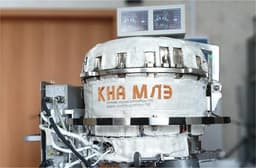
Specialists from Nizhny Novgorod State Technical University (NNSTU) and the Joint Institute for Nuclear Research (JINR) have developed a unique machine for laying roads on the ice of water bodies and removing snow and ice drifts. This was reported by the press service of the Ministry of Education and Science of the Russian Federation.

Under the guidance of Doctor of Technical Sciences, Professor Viktor Kulepov, a group of scientists from NNSTU, together with JINR, developed a technical project for a prototype ice planing machine (LPM-203). It is designed for cutting hummocks that form on Lake Baikal in winter and preparing a route for laying underwater cable lines connecting the optical modules of the Baikal Neutrino Telescope with the coastal control center.
The ice planing machine cleans the track using helical strips with installed cutters that remove the crushed snow and ice mass.
The Baikal Neutrino Telescope is a unique scientific installation designed to register Cherenkov radiation that occurs in water from the interaction of neutrinos with charged particles.
The telescope is located more than 3 km from the shore of Lake Baikal, its upper detectors begin at a depth of about 700 m and continue to 1.3 km to the bottom of the lake. The installation requires the delivery of equipment and machinery to remote locations, which is only possible in winter when the lake surface is covered with snow and ice.
Read more on the topic:
Unique sports cardiograph developed at NNSTU
New domestic voltage regulation unit for aviation created at NNSTU
NNSTU received a virtual power unit for training nuclear scientists