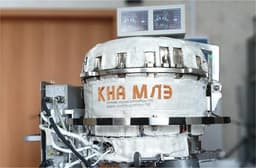
Specialists from Bauman Moscow State Technical University and FSUE VNIIA named after N.L. Dukhov have created a technology for manufacturing quantum systems on a chip. Thanks to it, scientists have developed and assembled an ultra-compact broadband parametric cryoamplifier for fast and highly accurate reading of the states of multi-qubit quantum coprocessors. It is more than 300 times smaller than similar devices of the previous generation.
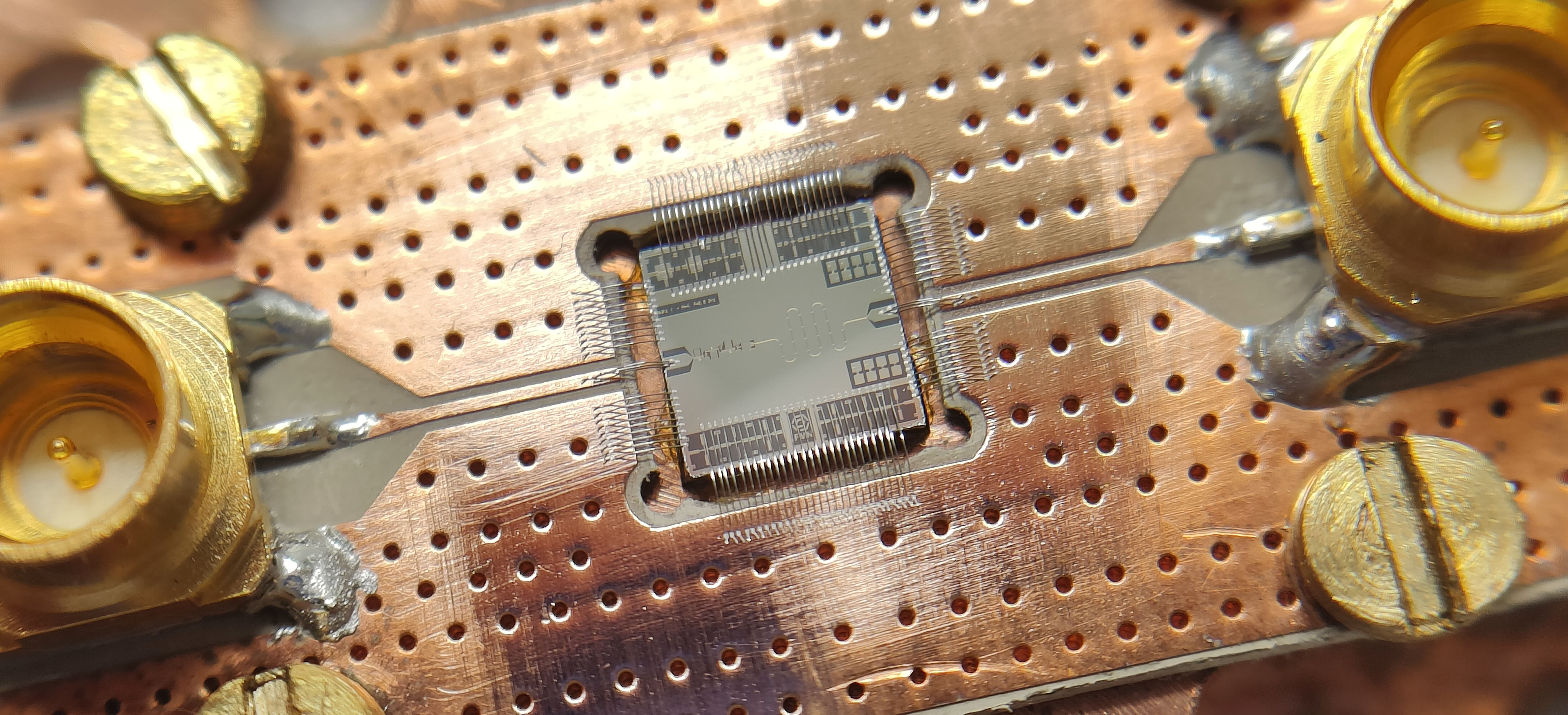
It took Russian scientists three years to reduce macroscopic quantum devices to microscopic scales and combine them into a single quantum system on a chip. The work was carried out on the basis of the Scientific and Educational Center Functional Micro/Nanosystems (SEC FMN) - a joint center of Bauman Moscow State Technical University and FSUE VNIIA named after N.L. Dukhov. These studies were actively supported by the Foundation for Advanced Research and the Ministry of Education and Science of Russia, including as part of the Priority-2030 program.
Our quantum system-on-a-chip technology is a complex of our own design methodology, the development of new materials (dielectrics with ultra-low losses), a quantum component base, its production technology, and methods of experimental characterization at cryogenic temperatures. The design of the new cryoamplifier chip is noticeably different from world analogues. We use a design consisting only of microscopic elements, such as plane-parallel capacitors and planar inductors. To form them, we worked out each technological operation in detail. As a result, we significantly reduced the dielectric losses of the material and brought them to the same level as the leading leaders in this field.
Ultra-low losses in plane-parallel capacitors make it possible to read the states of superconducting qubits as accurately as possible. Amorphous hydrogenated silicon with ultra-small dielectric losses is used as the dielectric layer of the capacitor in the device.
According to the press service of the Ministry of Education and Science, only a few fabs use similar technologies, in addition to Russian scientists. In particular, these are open digital production laboratories:
- NIST - National Institute of Standards and Technology of the USA, Google's technology partner;
- UC Santa Barbara - University of California, Santa Barbara, which has 12 research centers and institutes, including the Kavli Institute for Theoretical Physics;
- University of Maryland (UMBC) - University of Maryland, which develops high technologies.
Earlier in 2024, the first high-precision superconducting quantum processor in Russia was launched on the basis of SEC FMN . The average accuracy of its single-qubit operations was 99.76%, two-qubit operations - 99.11%, and reading accuracy - 96.18%.