At the Moscow Institute of Physics and Technology (MIPT) and RSC Energia, a new algorithm has been developed to control the orientation and docking engines to the orbital station on board the Russian lunar spacecraft PTK NP. The development will help optimize the flight path and reduce fuel consumption.
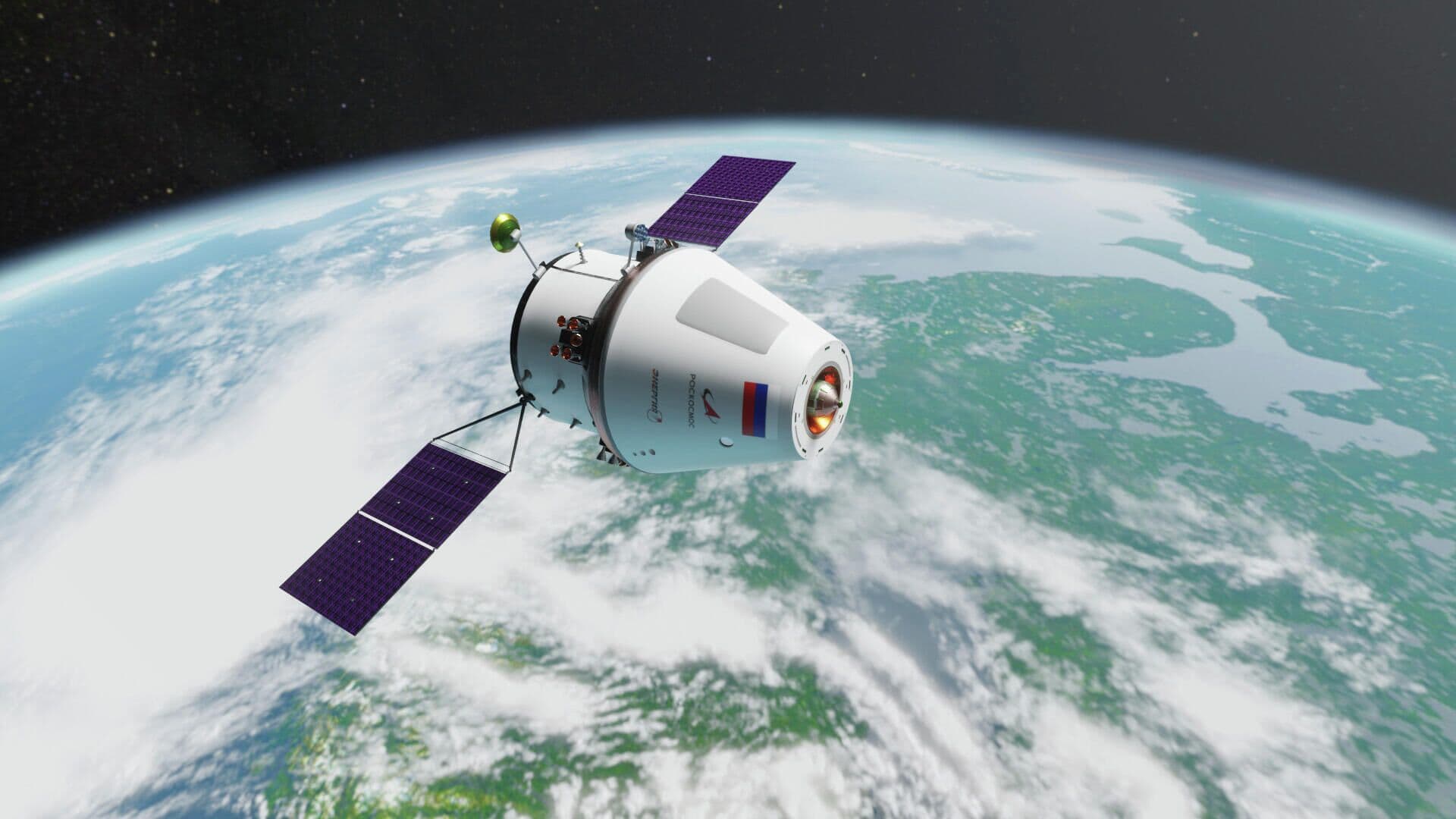
The proposed algorithm will automatically select the desired configuration of the involved power plants, as well as the strength and duration of their impulse, based on data on the position of the ship in space. This will allow you to perform the desired angular maneuver or adjust the trajectory of the spacecraft.
PTK NP (formerly known as "Federatsiya" and "Orel") is a promising manned transport spacecraft of a new generation. It is equipped with two powerful main engines with a thrust of 20 thousand Newtons. The ship has 30 orientation engines with a thrust of 248 Newtons, designed to correct the orbit and maneuver near the future lunar station.
A key feature of the new algorithm is the ability to individually control each of the engines. This optimizes fuel consumption and allows for more precise control of the speed and direction of the vehicle.
The on-board computer will update the engine operation scheme every 0.2 seconds to improve controllability. The algorithm is also capable of controlling the movement of the center of mass and angular maneuvers.
The developed approaches can also be applied to other spacecraft for docking and maneuvering modules of the future Russian orbital station.
The PTK NP spacecraft is designed to deliver people and cargo to space stations in near-Earth orbit and is part of the Russian lunar program. It should replace the manned spacecraft of the Soyuz series and will be able to be part of the orbital station for up to a year, and as part of the lunar station - up to 180 days. In autonomous flight, the orbital modification will be able to function for up to 30 days, and the lunar modification - up to 10 days.
Earlier www1.ru reported that a simulator for modeling the unmanned flight of the ship will be built at the Cosmonaut Training Center.
Read materials on the topic:
Russian space security system "Milky Way": what is known about it
Non-flying weather at NASA: Russian cosmonaut Alexander Grebenkin remained on the ISS
New Russian satellites "Ionosphere-M" have passed electrical tests