USC shared details on the progress of completing the oceanographic research vessel "Almaz." According to the USC press service, the loading of oversized equipment onto the vessel has already been completed at the "Yantar" shipyard. Currently, it is being installed, and preparations are underway for closing construction certificates.
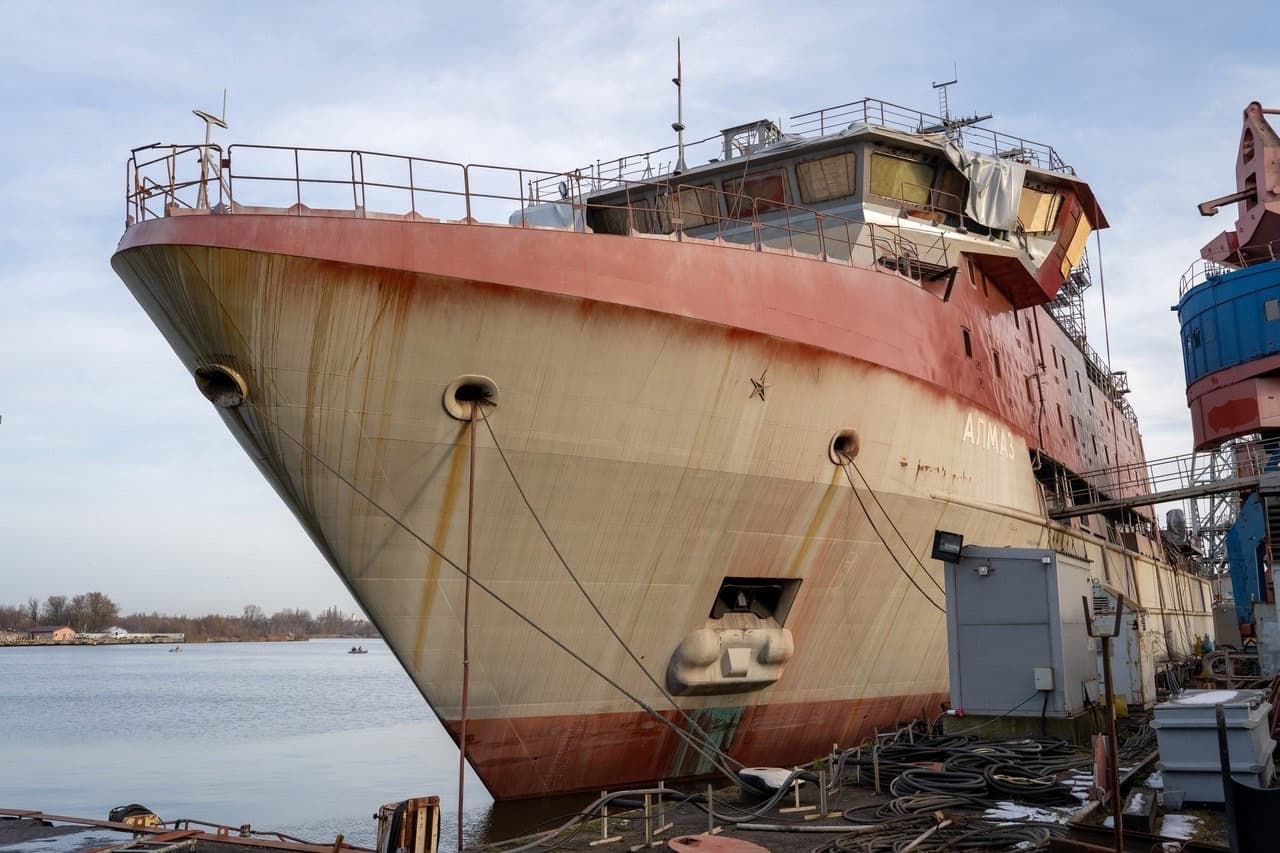
This allowed us to close all cutouts, and the ship's hull has taken its final form. In addition, we have installed all the portholes. That is, the ship is taking shape not only in terms of hull contours but also as a habitable object, if I may say so.
Inside, 99% of the internal spaces are insulated, with primary painting done inside and out. Work has begun on equipping cabins and installing sanitary units. The crane and stern P-frame have been installed and mounted. USC specialists have fully completed sandblasting, painting, and priming of the exposed parts of the hull and superstructure. Electrical installation work on the main high-section cable is 100% complete, and on the medium-section cable, it is 85% complete.
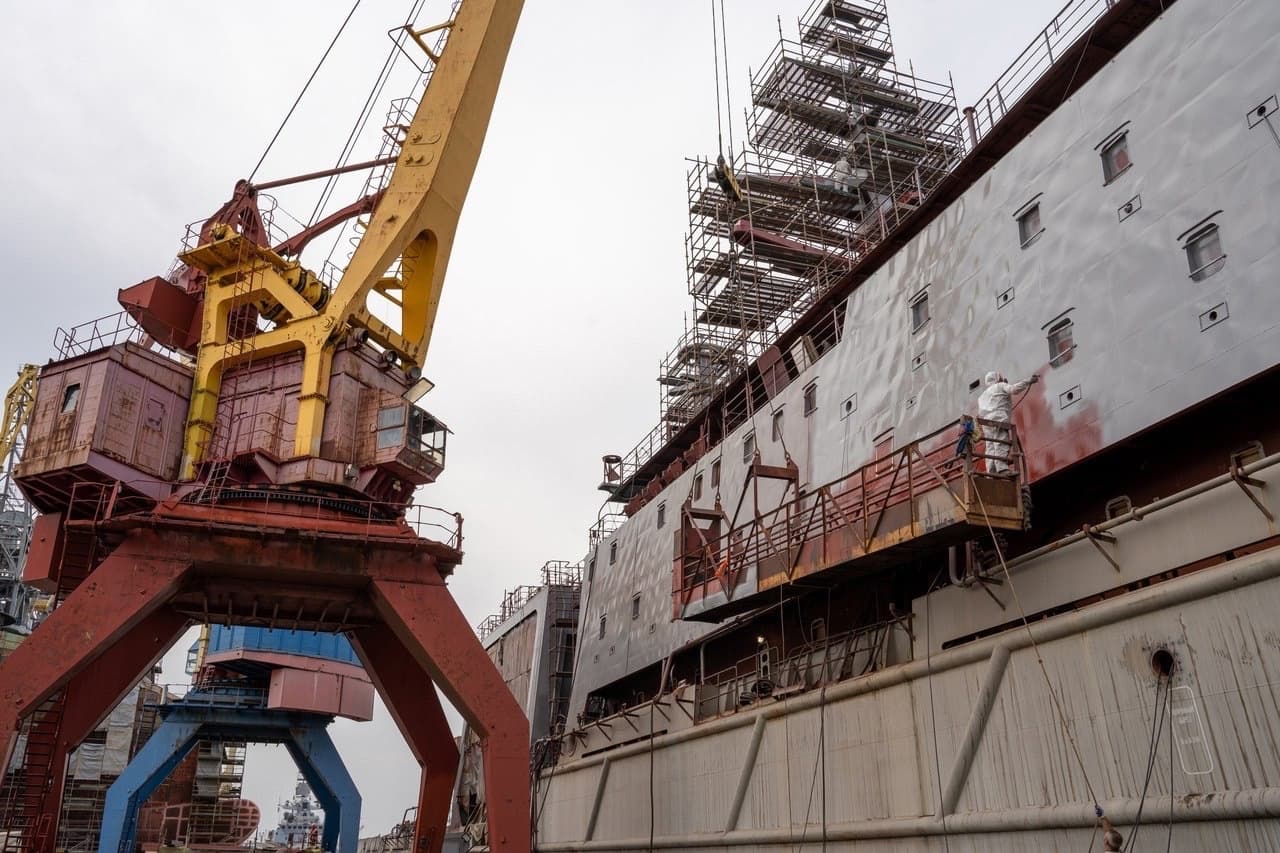
Specialists from USC "Arktika" are also working on this project. They have installed and connected 3,000 units of equipment out of 11,500.
In March 2025, the "Almaz" research vessel is scheduled to begin the pre-berthing period, with mooring trials expected to start in June, and sea trials closer to December 2025. The official delivery date is November 2026.
Project 22010
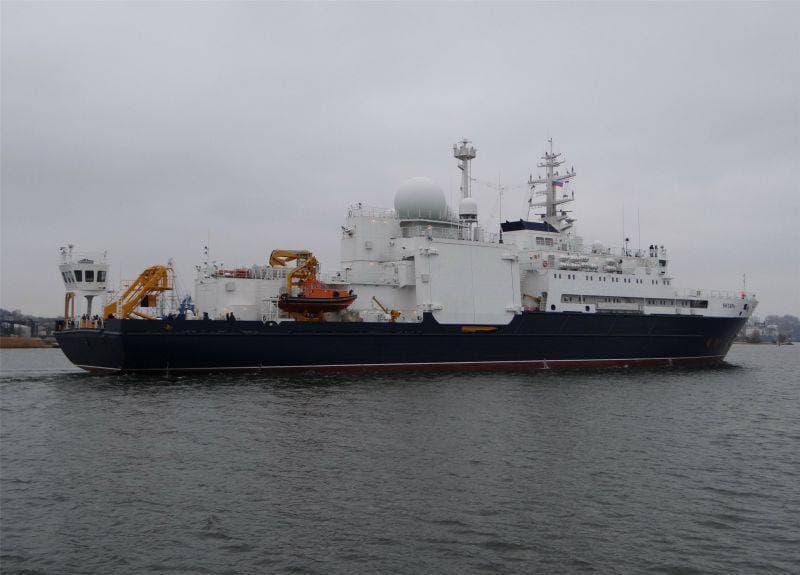
Project 22010, code name "Kryuys," comprises oceanographic research vessels with unlimited navigation areas, designed for exploring the World Ocean and solving a number of other tasks. The project was developed by the Central Marine Design Bureau (CMDB) "Almaz" in St. Petersburg. The lead ship of the project, "Yantar," was received by the Russian Ministry of Defense in 2015.
Little is known about the characteristics of the project's vessels:
- displacement - 5.2 thousand tons;
- length - 108.1 meters;
- width - 17.2 meters;
- full speed - 15 knots;
- crew - from 50 to 60 people;
- propulsion system - two screw-rudder columns with fixed-pitch propellers, two thrusters, and four diesel generators of 1600 kW each.
It is also known that the project's ship can operate with two manned autonomous deep-sea vehicles of Project 16810 "Rus" and Project 16811 "Consul." They are capable of descending to depths of up to 6,000 meters and 6,270 meters, respectively. "Rus" and "Consul" have a resource of up to 500 dives to a depth of more than 4,000 meters and 1,000 dives to a depth of up to 4,000 meters.
These vehicles can carry out underwater technical work using a manipulator device, inspect underwater objects and structures. If necessary, they can deliver various items weighing up to 200 kg to the seabed or raise them to the surface.
Also, according to some reports, Project 22010 research vessels can be equipped with "Mir" deep-sea vehicles.
Read more on the topic:
An information system for digital shipyards has been developed in Russia
Russia proposes the production of a new composite catamaran of Project N24
It became known what the new Russian catamaran for fish farms looks like
Fleet of the Future: USC showcases new ship designs at the Maritime Congress in Vladivostok
Now on home

Start of deliveries scheduled for 2027

Over 51,000 new motorcycles were sold in Russia in 2025

The car will take at least a year to assemble

The application's audience has reached 20 million users

The model will be included in the list of cars for taxis, price - from 2.25 million rubles

All parking lots of the "Administrator of the Moscow Parking Space" are connected to the service

The cars will be supplied to the Moscow Transport Service Directorate

Deliveries to India may begin in 2028

The technology provides automated search for all types of defects in power units

The plane flew 500 km, accelerating to 425 km/h

The plant stated that the information about the termination of purchases for models 6 and 8 is not true

Scientists are using the "Ekran-M" installation