A domestic vacuum magnetron sputtering system has been developed at Peter the Great St. Petersburg Polytechnic University (SPbPU). This was reported by the press service of the Ministry of Science and Higher Education of the Russian Federation.

The new system allows applying the thinnest coatings from various materials by sputtering atoms. Such coatings are used in microelectronics, optoelectronics, and photovoltaics.
The laboratory setup, developed by engineers of the NCMU SPbPU, is designed for deposition of various materials on silicon, silicon carbide, diamond, quartz substrates by sputtering target atoms. The main purpose of the new system is the deposition of metals of a given thickness from 10 nm to tens of μm on substrates used in the semiconductor industry.
In the process of vacuum magnetron sputtering, the target plays a key role - the source of material for the coating. When voltage is applied to the magnetic system, the magnetron generates plasma in an inert gas atmosphere. Atoms released by ions are deposited on the surface of the object, forming a thin layer.
Our system can replace widely used foreign-made complexes. Also, with its help, it is possible to modernize equipment at small-scale enterprises that has been in operation since the Soviet period in a very short time: 3-4 months when supplying a basic vacuum magnetron and 9 months in the case of developing a magnetron for more complex requirements.
The new system sputters not only ferromagnetic metals, but also materials with more complex properties. The oxide of this material is used in the creation of solar cells as antireflection coatings and in applications requiring transparent conductive contacts.
Earlier,www1.ru reported that in Russia a new installation has beendeveloped for checking the quality of composites in aviation and space.
Read materials on the topic:
Faster by tens of percent: Russian scientists have come up with a way to speed up microprocessors
Now on home

Start of deliveries scheduled for 2027

Over 51,000 new motorcycles were sold in Russia in 2025

The car will take at least a year to assemble

The application's audience has reached 20 million users

The model will be included in the list of cars for taxis, price - from 2.25 million rubles

All parking lots of the "Administrator of the Moscow Parking Space" are connected to the service

The cars will be supplied to the Moscow Transport Service Directorate

Deliveries to India may begin in 2028

The technology provides automated search for all types of defects in power units

The plane flew 500 km, accelerating to 425 km/h

The plant stated that the information about the termination of purchases for models 6 and 8 is not true
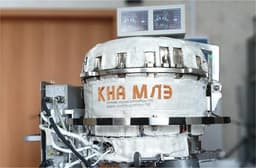
Scientists are using the "Ekran-M" installation