Since August 2024, the Russian military has been successfully using the FPV drone with fiber optic cable control "Knyaz Vandal Novgorodsky" (KVN). The new method of manipulating the device was called "Groza-Leska."
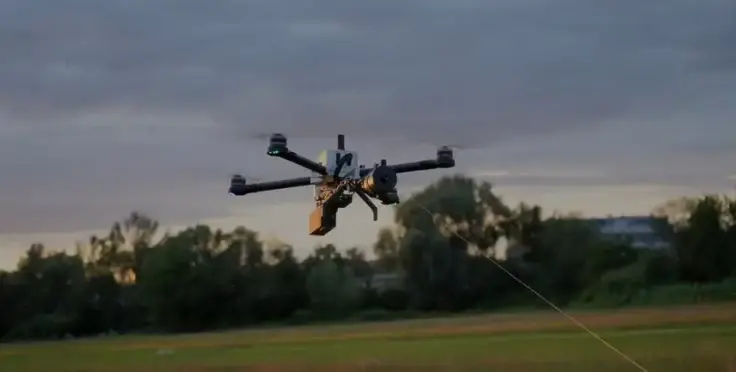
Neutral to the effects of electronic warfare (EW) systems, the fiber optic line provides drone control and video transmission to the operator.
The line is quite fragile - if bent, it breaks easily. However, statistics on fiber optic breaks do not exceed 1-2 cases per 10 launches. The clarity of the image transmitted by the drone before the strike is excellent. There are no signals here that can be suppressed, intercepted, or influenced by electronic warfare means.
The working range of flight is 6-10 km. Thanks to the large power reserve, the KVN slowly hovers over enemy positions at an altitude of 2-10 m, observing the situation, and then attacks the selected target.
At the end of November, fiber optic drones began to be equipped with night vision cameras. Now the KVN combines the functions of a reconnaissance and strike kamikaze drone.
The tactical and technical characteristics of the FPV drone "Knyaz Vandal Novgorodsky" are not disclosed. With a high degree of probability, the device, like other small FPV quadcopters, has a total mass with a battery of up to 1.5-1.9 kg, is capable of speeds up to 100-140 km/h, and carries ammunition weighing up to 3-4 kg. The mass of the fiber optic reels themselves is unknown.
Earlier, the Russian Ministry of Defense showed footage ofstrikes on heavy equipment using FPV drones from the Rubikon advanced unmanned technology test center.
Read more materials:
Sees 150 km ahead: what the latest Irbis ground-based radar is capable of for the Russian army
Now on home

Start of deliveries scheduled for 2027

Over 51,000 new motorcycles were sold in Russia in 2025

The car will take at least a year to assemble

The application's audience has reached 20 million users

The model will be included in the list of cars for taxis, price - from 2.25 million rubles

All parking lots of the "Administrator of the Moscow Parking Space" are connected to the service

The cars will be supplied to the Moscow Transport Service Directorate
Deliveries to India may begin in 2028
The technology provides automated search for all types of defects in power units
The plane flew 500 km, accelerating to 425 km/h

The plant stated that the information about the termination of purchases for models 6 and 8 is not true
Scientists are using the "Ekran-M" installation