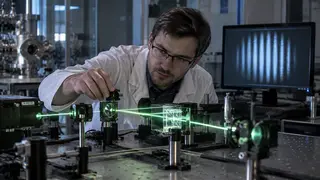
Specialists from the Institute of Laser Physics (ILF) SB RAS and the Institute of Applied Physics (IPF) RAS conducted a unique experiment on the KI-1 facility to collide plasma flows in a magnetic field. As reported by TASS at the National Center for Physics and Mathematics, for the first time in the world, it was possible to simulate in detail the birth of highly directed plasma jets — similar to those emitted by young stars and supermassive black holes.
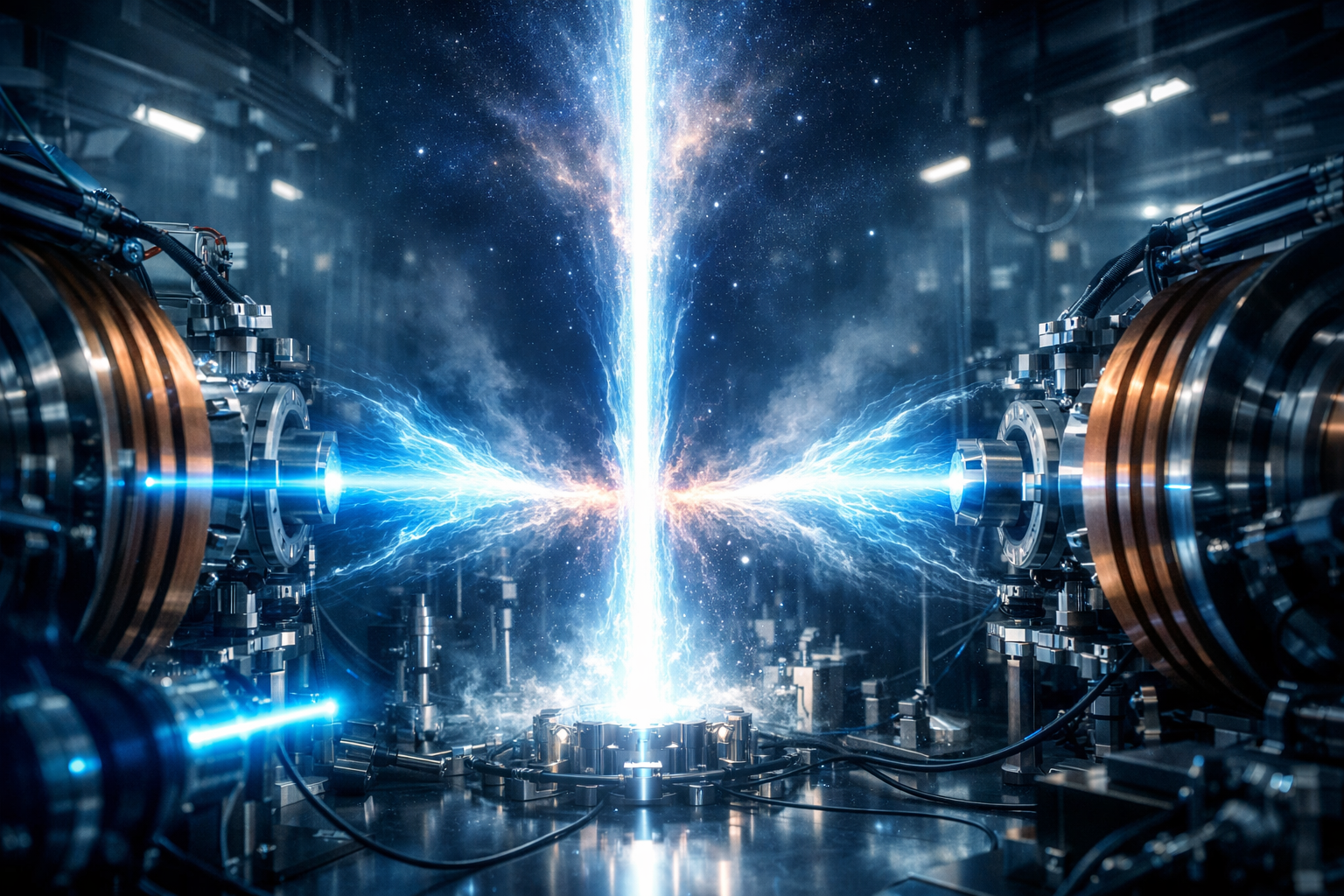
The laser evaporated the target, creating a wide plasma plume, which, under the influence of the magnetic field, compressed into a dense beam.
These experiments are not just laboratory exotica. They help to understand the most grandiose phenomena in the Universe, where stars are born, and giant black holes emit jets of plasma for millions of light-years.
During the experiments, the separation of particles was recorded: light hydrogen protons concentrated in a narrow core of the jet, while heavy carbon ions were distributed much wider.
The result has direct applied significance for predicting space weather. By modeling collisions of plasma jets, scientists can more accurately predict the behavior of the Earth's magnetic field during solar flares — it is these disturbances that disable satellites, disrupt communication, and create interference in power grids. The experiment confirms the possibility of laboratory reproduction of processes that are stretched for millions of light-years in space.
Read more materials on the topic:
- Russian terahertz laser enters mass production after a full cycle of testing: readiness time for work — 20 minutes
- Scientific breakthrough: the world's first continuous spectrum white laser created by scientists of the SB RAS
- Will detect space debris at a distance of up to 3.5 thousand km: powerful optics for a new telescope created in Rostec
Never miss our newsAdd this site to your preferred sources to see us more oftenAdd on Google