Translated with AI from the Russian original.
Physicists from the National Research Nuclear University MEPhI have created an experimental complex for measuring magnetic fields in spherical tokamaks. The development allows to detect distortions that computer models do not account for, "Pervy Tekhnichesky" was informed by the university.
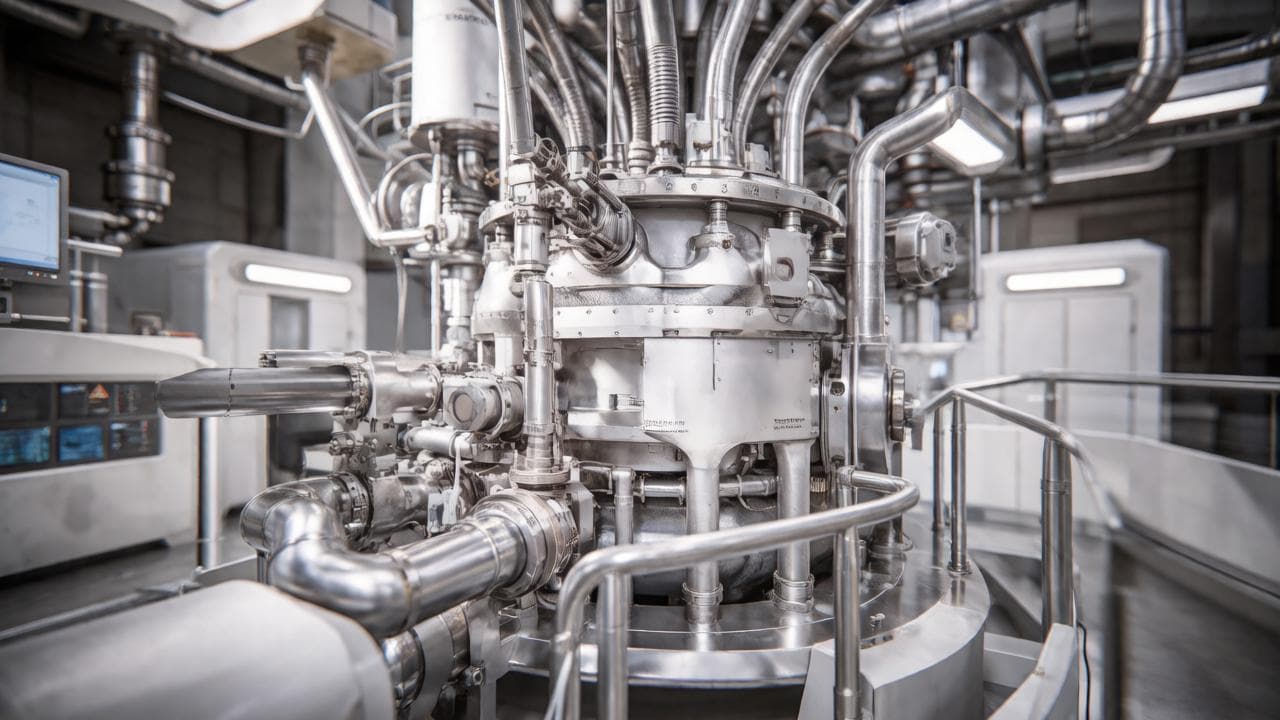
The magnetic field in a tokamak holds the plasma, preventing it from touching the chamber walls. However, microscopic assembly inaccuracies of the coils – wire shifts during winding and misalignments during installation – generate parasitic vertical and and radial fields. These distort the shape of the plasma column, reduce the stability of confinement, and ultimately can interrupt the thermonuclear reaction. Standard computer calculations do not always predict such distortions.
To verify the calculations, scientists built a physical model – a scaled-down copy of the MEPhIST-1 tokamak at a one-to-three scale. The torus was 3D-printed, copper wire was laid in the grooves, and the structure was made collapsible to allow for configuration changes. For measurements, a printed circuit board with 36 three-component Hall sensors was developed. The system autonomously polls the sensors at a frequency of 1000 hertz and records data in built-in memory.
At a current of 180 amperes, parasitic components could not be detected due to noise. When the current was increased to 1200 amperes, measurements showed that the main parasitic component – the vertical field – corresponded to theoretical predictions. However, the ratio of the magnitude of parasitic fields to the main field was several times higher than calculated.
The obtained discrepancy indicates the presence of unaccounted factors: connecting wires, microscopic coil misalignments, and sensor tilts introduce distortions that are not captured by computer modeling. These data will allow correcting the design of future thermonuclear reactors and determining the permissible level of assembly inaccuracy at which plasma confinement remains stable.
Read more on the topic:
Never miss our newsAdd this site to your preferred sources to see us more oftenAdd on Google

















