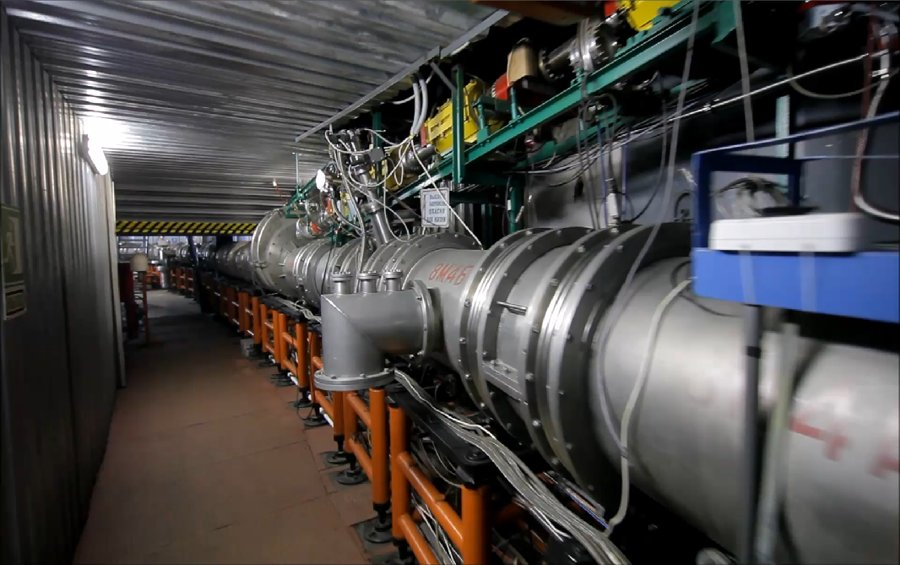
Scientists from Tomsk State University have created and successfully tested an experimental sample of the L2 concentrator board for the Russian NICA collider, located in Dubna. The development was carried out within the framework of a mega-grant from the Russian government and will become an important element of the information collection and transmission system in a large international project uniting more than 40 organizations from different countries.
The L2 board provides the conversion of large data arrays from detectors into a format convenient for analysis. We are currently finalizing the experimental sample for integration into the installation and compliance with all collaboration requirements.
By the beginning of the SPD (Spin Physics Detector) experiment, scheduled for 2028, specialists must fully prepare the electronics and software responsible for collecting, processing, and transmitting data to servers for analysis.
The SPD experiment is designed to recreate the state of the Universe in the first moments after the Big Bang — quark-gluon plasma — and to investigate how protons and neutrons were formed from it. These studies will help to verify or refine the existing theory of the origin of the Universe.
The superconducting collider NICA (Nuclotron based Ion Collider Facility) is one of the Russian mega-science class projects designed to bring humanity closer to understanding how matter arose from primary particles, and then stars, planets, and everything around us.
Read more materials:
Now on home

Start of deliveries scheduled for 2027

Over 51,000 new motorcycles were sold in Russia in 2025

The car will take at least a year to assemble

The application's audience has reached 20 million users

The model will be included in the list of cars for taxis, price - from 2.25 million rubles

All parking lots of the "Administrator of the Moscow Parking Space" are connected to the service

The cars will be supplied to the Moscow Transport Service Directorate
Deliveries to India may begin in 2028
The technology provides automated search for all types of defects in power units

The plane flew 500 km, accelerating to 425 km/h

The plant stated that the information about the termination of purchases for models 6 and 8 is not true
Scientists are using the "Ekran-M" installation