Russia has taken a step towards conquering deep space: the Keldysh Center has completed the development and testing of two unique high-power plasma engines. These installations will form the basis of future missions to the Moon, Mars, and even the distant planets of the Solar System.
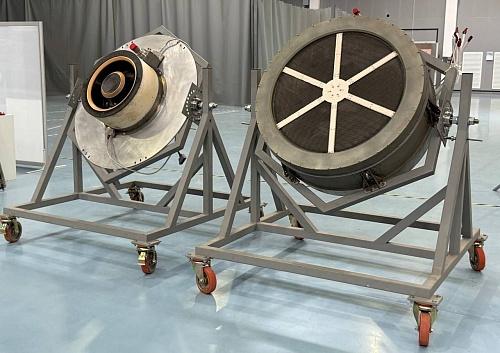
The new engines - the Hall thrusterKM-50M and the ion thrusterID-750 - have no world analogues. The first was created using magnetic shielding technology and is capable of operating for more than 20,000 hours. The second uses carbon-carbon composites and demonstrates a record resource of over 50,000 hours. Both engines run on inert gases - xenon and krypton, which are safe and suitable for long-term storage in space.
KM-50M develops thrust up to 1.6 Newtons and a specific impulse of 4200 seconds, and its modular tests in a vacuum confirmed the possibility of cluster application.ID-750, with a power of 80 kW, accelerates plasma to a speed of 100 km/s, which opens the way to interplanetary flights in a compressed time frame. Testing of three such installations at once proved their reliability and stability.
To operate such powerful systems, a compact nuclear power source is required. Specialists have already created a prototype turbine installation that converts reactor heat into electricity. It is capable of delivering the necessary power for cruise engines, which makes long-range expedition projects a reality.
The transition from chemical engines to plasma engines makes it possible to increase the payload capacity of spacecraft, speed up flights, and reduce the cost of space exploration. For Russia, this is a chance to maintain leadership in electric propulsion technologies.
Read materials on the topic:
- Maintaining technological potential: Russia is the leading manufacturer of plasma engines for spacecraft
- Russian scientists have created a system for calculating the parameters of a plasma engine unit for nanosatellites
- Russian SPD-70M plasma engines on xenon and krypton will be launched into mass production
Never miss our newsAdd this site to your preferred sources to see us more oftenAdd on Google

















