Translated with AI from the Russian original.
Scientists from Perm Polytechnic University (PNRPU) have presented a new method of intelligent 3D printing of large-sized parts. The development was created jointly with "F2 Innovations" company and has already been tested on serial equipment.
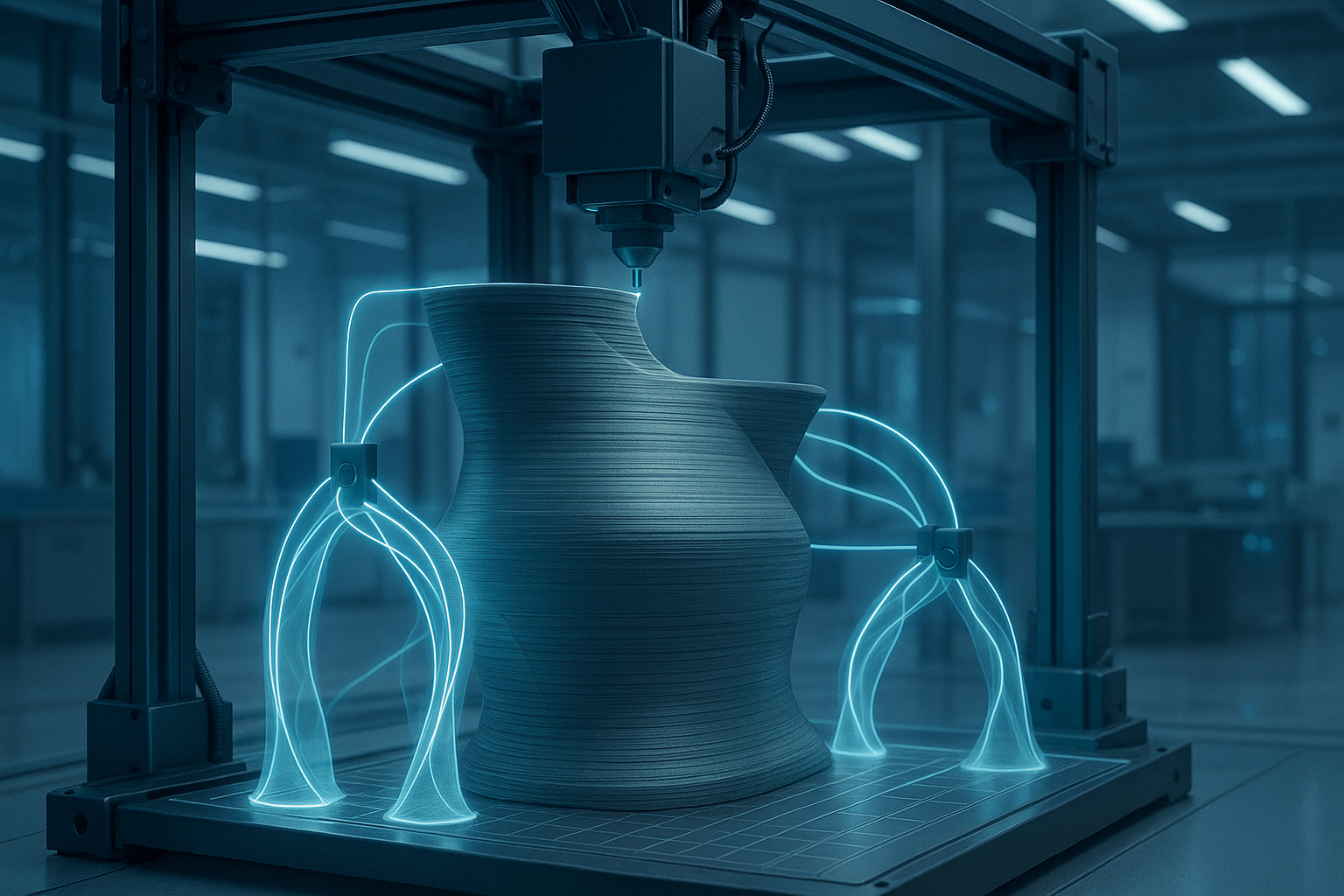
The main innovation of the technology is the use of "smart" mechanical supports integrated directly into the design of the 3D printer. These elements automatically support the overhanging parts of the product during printing, moving synchronously with the extruder, and then are removed without leaving traces on the surface. This approach avoids deformation, increases accuracy, and allows printing more complex shapes.
Unlike traditional supports, which are printed from the same material as the part itself, Perm engineers used independent movable elements. Their shape can be changed by folding or moving, which reduces the load on the not yet hardened polymer. This opens up opportunities for printing large parts with horizontal layer orientation or at angles of 45° and 90°, where conventional methods cannot cope.
The control system determines in advance where reinforcement is needed and directs the mechanical elements to the right place. As a result, the process proceeds continuously and without defects
Similar technologies are in demand all over the world. In the USA and China, industrial 3D printers are actively being developed for the construction of buildings and the production of aircraft parts. The Russian development may occupy a niche in mechanical engineering, energy and the space industry, where high accuracy is required when printing large-sized products.
Read materials on the topic:
- Rostec showed how 3D printing of aircraft engine parts works
- New perspectives in the aviation and nuclear industries: Rosatom presented the first industrial 3D printer - RusMelt 600M
- ODK has developed a revolutionary technology for casting parts of gas turbine engines
Never miss our newsAdd this site to your preferred sources to see us more oftenAdd on Google

















