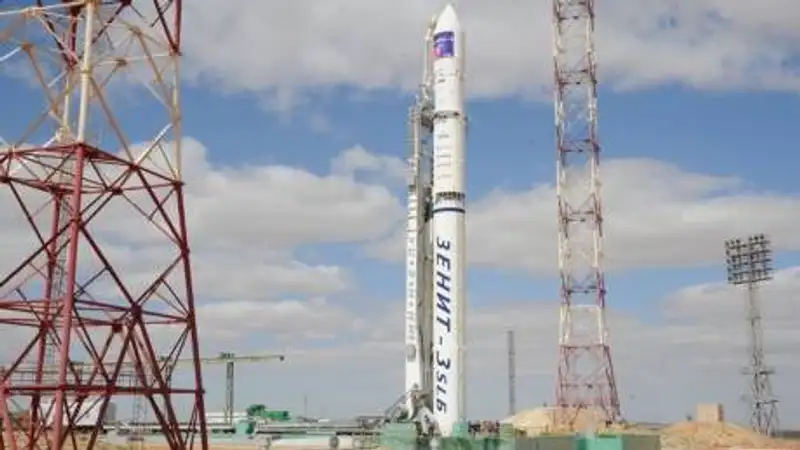
Kazakhstan seeks to accelerate flight tests of the Baiterek space rocket complex as part of a joint project with Russia. This is necessary for the early start of commercial launches. This was stated by Malik Olzhabekov, Deputy Minister of Digital Development, Innovation and Aerospace Industry of Kazakhstan.
We are interested in conducting them a little faster and starting commerce earlier. Because the time distance until 2028 is long. But it will depend on how successful our test launches will be.
Earlier it was planned that launches with cargo would begin to be carried out from 2028.
"Baiterek" is a joint Russian-Kazakh space rocket complex, which is being implemented at the Baikonur Cosmodrome under an agreement of 2004.
The purpose of the project is to create an environmentally friendly medium-sized rocket with increased payload capacity for launching automatic spacecraft into near-Earth orbits and infrastructure for its launch.
According to information as of September 2025, the first test launch of the Soyuz-5 rocket from the Baiterek complex is scheduled for December 2025, the complex is already 77% ready.
Read more on the topic:
Sobyanin: four new stations of the Troitskaya metro line may open on City Day
"Oreshnik" and its shadow: Russia hinted at the development of a new, more powerful weapon
50 all-wheel drive trucks BAZ S32A51 assembled at the Romanov automobile plant in St. Petersburg
Giant crane successfully tested at the construction site of the Leningrad NPP-2
Now on home

Start of deliveries scheduled for 2027

Over 51,000 new motorcycles were sold in Russia in 2025

The car will take at least a year to assemble

The application's audience has reached 20 million users

The model will be included in the list of cars for taxis, price - from 2.25 million rubles

All parking lots of the "Administrator of the Moscow Parking Space" are connected to the service

The cars will be supplied to the Moscow Transport Service Directorate

Deliveries to India may begin in 2028

The technology provides automated search for all types of defects in power units

The plane flew 500 km, accelerating to 425 km/h

The plant stated that the information about the termination of purchases for models 6 and 8 is not true

Scientists are using the "Ekran-M" installation