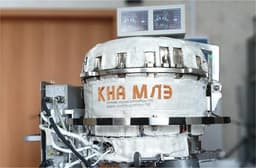
The National Center for Physics and Mathematics (NCPM) in Sarov has announced that the development of nuclear clocks will significantly improve the accuracy of satellite navigation systems such as GPS and GLONASS. In addition, these clocks will allow measuring fundamental physical constants with a high degree of accuracy, including the gravitational constant, which will open up new opportunities for testing the foundations of the general theory of relativity on a cosmological scale.

Nuclear clocks, thanks to their small size and high stability, will surpass atomic clocks in accuracy and open up the possibility of registering the influence of the gravitational field on the transition frequency.
Such clocks will help solve the problems of fundamental physics, detect mineral deposits and create high-precision geoid navigation maps
According to the scientist, the development of nuclear clocks is a priority for leading research centers around the world. Despite the long-standing idea of using the isomeric transition of thorium-229 as the basis for clocks, it was only in 2024 that the first significant practical achievements were made in this area.
Read materials on the topic:
China and Russia will join forces in education and science: an agreement has been concluded
Roscosmos and China will build a power plant on the moon: Putin and Xi Jinping signed a memorandum