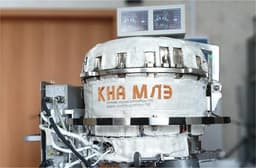
At the Sarov National Center for Physics and Mathematics (NCFM), work is underway to create a new generation of nuclear clocks that promise to significantly improve the accuracy of navigation satellite systems such as GPS and GLONASS. These clocks are based on nuclear transitions of the thorium-229 isotope and will be more compact, stable, and accurate compared to modern atomic clocks.
Nuclear clocks will be able to measure fundamental physical constants with high accuracy, including the gravitational constant, which will allow testing the main provisions of the general theory of relativity and deepen the understanding of cosmological effects. In addition, they will help create accurate geographic maps and detect mineral deposits at a distance.
The difference between nuclear clocks is the protection of transitions from external influences due to the electronic shell, which increases the accuracy of measurements by several orders of magnitude.
The isomeric transition in the nucleus of the thorium-229 isotope with an energy of about 8.3 eV, the frequency of which is in the vacuum ultraviolet region and is available for existing laser sources, looks most promising for the construction of nuclear clocks.
Improving the accuracy of time in navigation systems directly affects the efficiency and safety of transport, communications, and scientific research. In addition, the new clock will open up opportunities for fundamental tests of the laws of physics and improve the monitoring of natural resources.