Nanostructured magnetic materials that retain their properties at temperatures up to 550 degrees Celsius have been created at Tver State University (TSU). This was announced by Alexey Karpenkov, Head of the Laboratory of Magnetic Materials and the Department of Condensed Matter Physics at TSU.
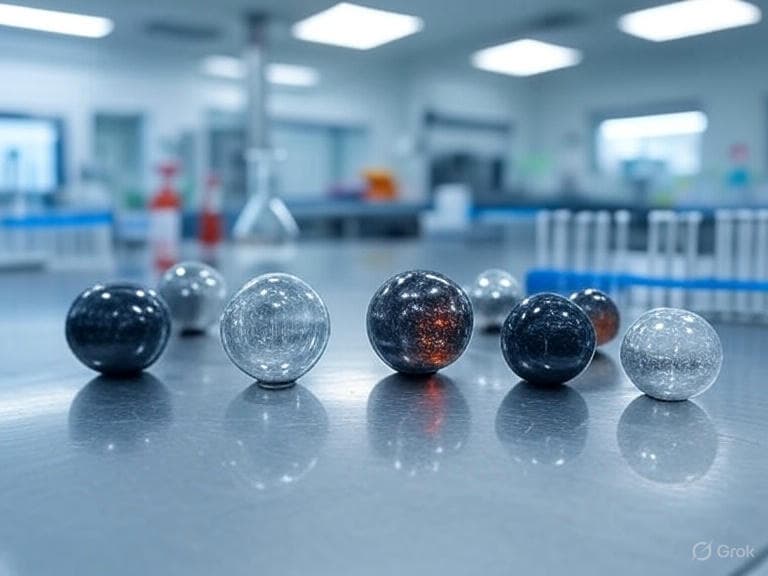
High-temperature magnets based on the rare-earth metal (REM) Co-Fe-Cu-Zr system are unique materials due to their exceptional thermal stability at elevated temperatures (up to 400-550 degrees). This makes them indispensable in areas where conventional magnets lose their properties.
According to Karpenkov, permanent magnets based on Nd-Fe-B alloys are currently leading the consumer market. However, they lose their magnetic properties at temperatures above 200°C. Modern microelectronics and instrument engineering devices require permanent magnets to have not only high magnetic characteristics but also stability of these properties over a wide temperature range.
The developed magnets can be used in electric motors, generators, gyroscopes, and navigation systems in the aerospace and aviation industries, as well as in guidance and control systems, radar systems, electric motors for military equipment, equipment for measurements during drilling in the oil and gas industry, and in magnetic resonance imaging scanners.
Earlier, www1.ru reported that scientists from the Budker Institute of Nuclear Physics (BINP) SB RAS developed and manufactured five pulsed magnets, which are key elements of the SKIF booster.
Read related materials:
SKIF Shared Resource Center to be launched in 2025: postponement due to sanctions
Linear accelerator of the SKIF Shared Resource Center begins to be installed near Novosibirsk
Now on home

Start of deliveries scheduled for 2027

Over 51,000 new motorcycles were sold in Russia in 2025

The car will take at least a year to assemble

The application's audience has reached 20 million users

The model will be included in the list of cars for taxis, price - from 2.25 million rubles

All parking lots of the "Administrator of the Moscow Parking Space" are connected to the service

The cars will be supplied to the Moscow Transport Service Directorate

Deliveries to India may begin in 2028
The technology provides automated search for all types of defects in power units

The plane flew 500 km, accelerating to 425 km/h

The plant stated that the information about the termination of purchases for models 6 and 8 is not true
Scientists are using the "Ekran-M" installation