Specialists from the Russian Technological University MIREA have created photodetectors that not only capture light with high accuracy, but also recognize its polarization. These devices, created on the basis of two-dimensional materials, can become the basis for the development of a new generation of smart watches, fitness trackers and other wearable devices.
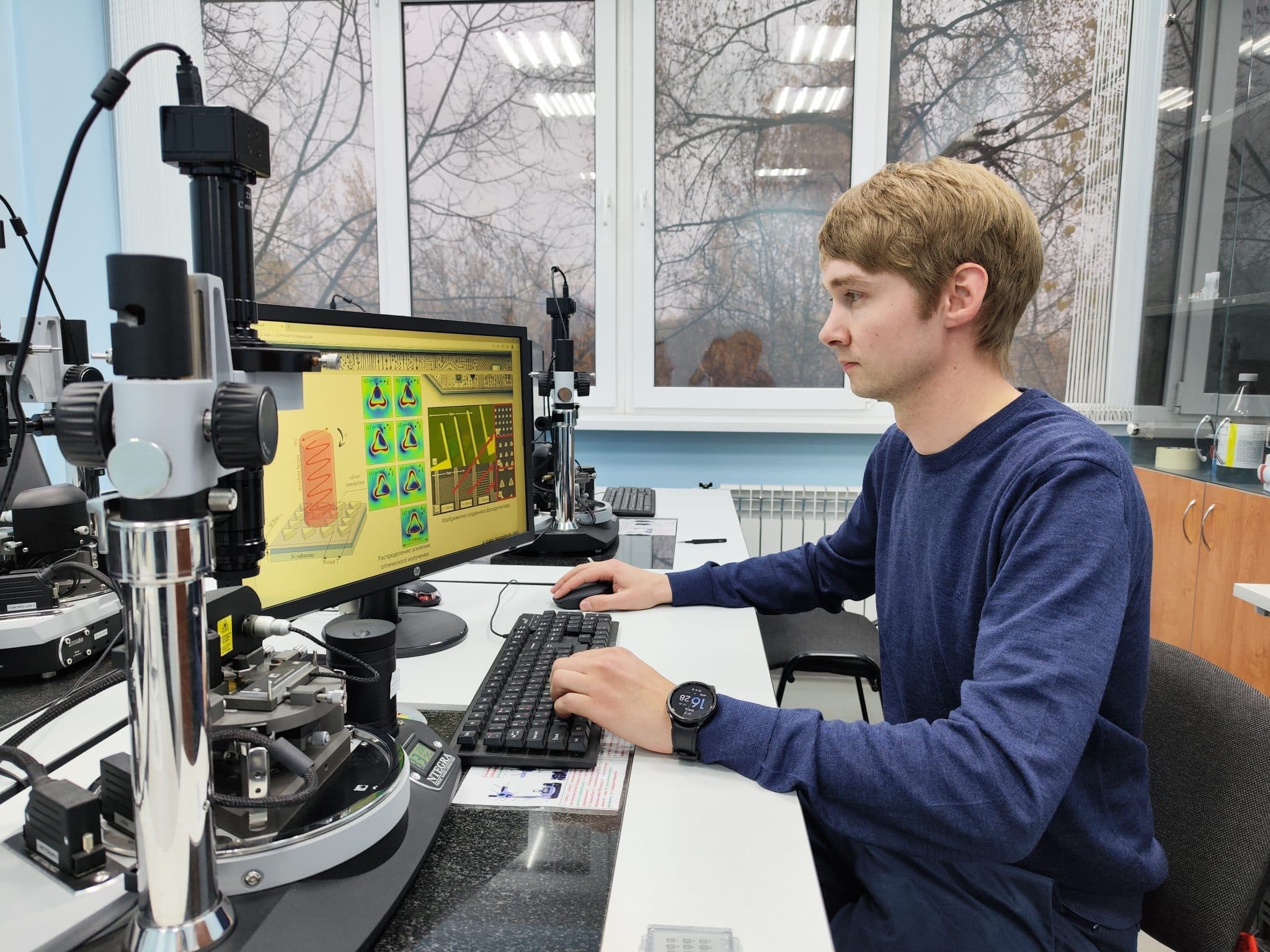
Due to their high photosensitivity, they can be used to track key biometric indicators, such as heart rate or blood oxygen levels.
The development is based on thin layers of molybdenum disulfide (MoS2), which have many defects. These defects, contrary to expectations, play an important role: they significantly improve the sensitivity of sensors to light, but slow down their speed.
Another problem with such sensors is the weak absorption of light by films one atom thick. To solve it, scientists used asymmetric plasmon lattices. These structures enhanced light absorption by more than 50 times and allowed the sensors to distinguish its polarization. At the same time, the devices remained flexible and thin. However, the use of plasmon structures increased the number of defects, which slowed down the operation of the sensors.
A large number of defects led to a slowdown in signal processing and an increase in response time to several thousand seconds. To solve this problem, specialists developed a special algorithm based on a dynamic mathematical model. This algorithm allows you to quickly analyze photon signals and calculate the final values of the photocurrent. Thanks to this, the response time of the devices was reduced hundreds of times. This makes the sensors suitable for integration into flexible wearable devices.
Our photodetectors demonstrate impressive characteristics: photoresponse of about 60 mA/W and sensitivity to light polarization up to 80%. Imagine that a sensor is a thin network designed to capture light. Defects in molybdenum disulfide films act as additional nodes that capture more photons and increase sensitivity. And asymmetric plasmon lattices act as guides that collect and focus light of a certain polarization in the desired areas of the sensor. Thus, the device can "tune" the network to light with a specific direction of waves and distinguish its polarization.
Currently, there is a shortage in the market of flexible photodetectors that could simultaneously provide high sensitivity and the ability to recognize light polarization. The development created by RTU MIREA specialists not only fills this gap, but also provides new opportunities for creating lightweight, durable and functional portable devices.
Such sensors can be used in optical communication systems, polarized image forming devices, optical radars and nanophotonics.
We were able to combine high sensitivity, the ability to distinguish polarization and a fast reaction time in one device. This makes our photodetectors promising for a wide range of applications, from medical gadgets to high-tech communication systems.
Earlier, scientists from the Moscow Institute of Physics and Technology, together with the company "Skanda Rus", createdinfrared photodetectors that work without electricity. The development is based on a metal pattern with sharp edges on graphene.