Specialists from IKI RAN and ISZF SB RAS recorded a rapid increase in the solar wind, which reached Earth in the morning.
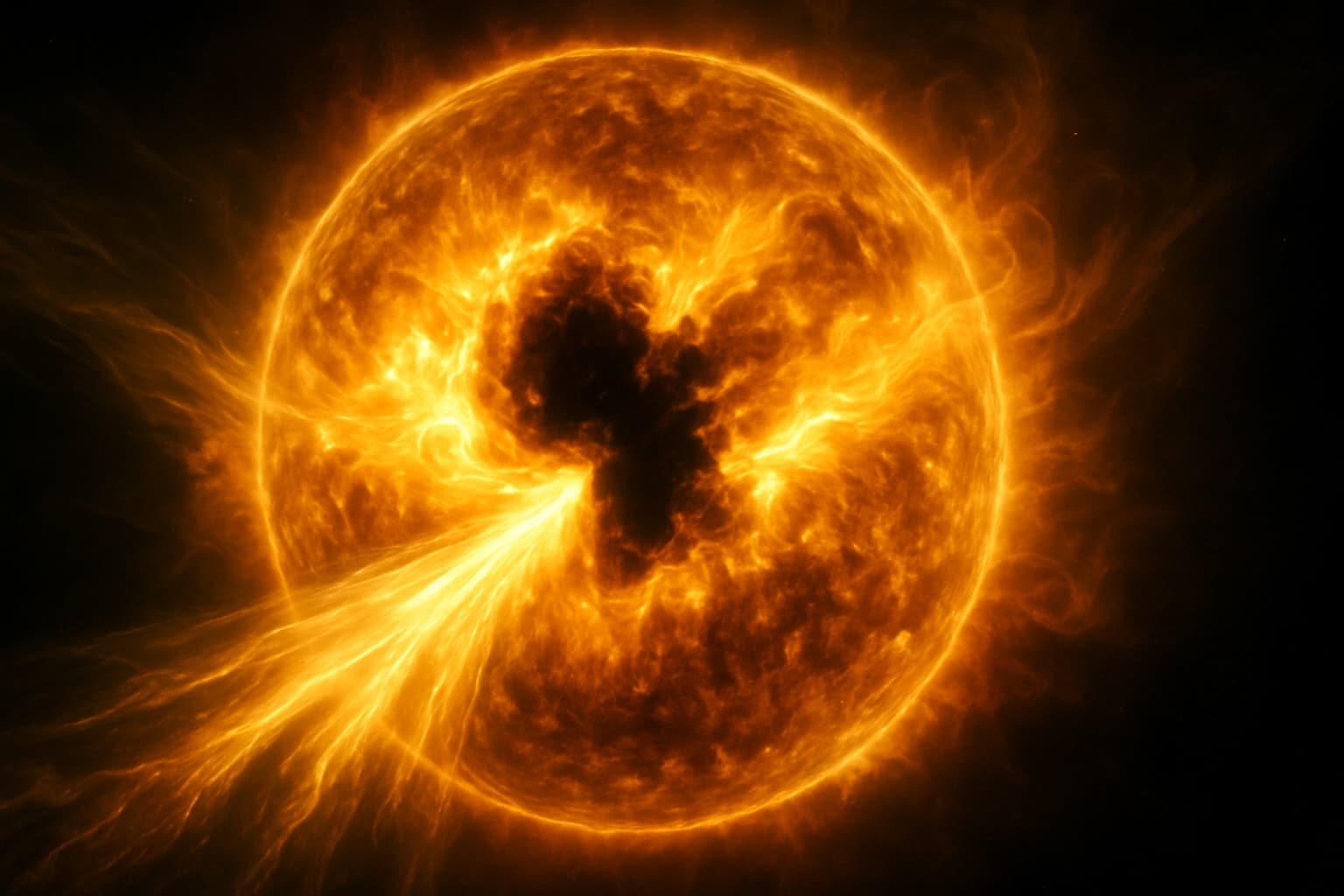
In a few hours, the speed of charged particle flows increased from 400 to 600 km/s. The temperature of the near-Earth plasma rose to 700 thousand degrees. At the same time, the density of the interplanetary gas decreased sharply - a characteristic sign of the impact of a coronal hole, and not a standard mass ejection.
The coronal hole - an area in the solar atmosphere with an open magnetic field - continues to expand, which led to a correction of forecasts. Initially, the peak of activity was expected today, but due to the dynamics of the phenomenon, it shifted to tomorrow. Scientists note that the situation requires constant real-time monitoring, as the key factor will be the direction of the magnetic field in the solar wind.
The first fluctuations have already been recorded in the Earth's magnetosphere, without reaching the level of a full-fledged storm. However, the probability of geomagnetic indices transitioning to the "red zone" is estimated as maximal. The main scenario involves a G2 level storm (moderate intensity) with a 10% chance of intensifying to G3. This may cause malfunctions in satellites, power systems, and communication systems.
Read materials on the topic:
Magnetic storms are expected in the coming days: geophysicists have announced a storm warning
New coronal hole on the Sun: a new magnetic storm is expected on Monday
The strongest magnetic storms will cover the Earth on April 22