Astronomers from Novosibirsk State University have for the first time in Russia captured Mercury's sodium tail, resembling a comet's tail.
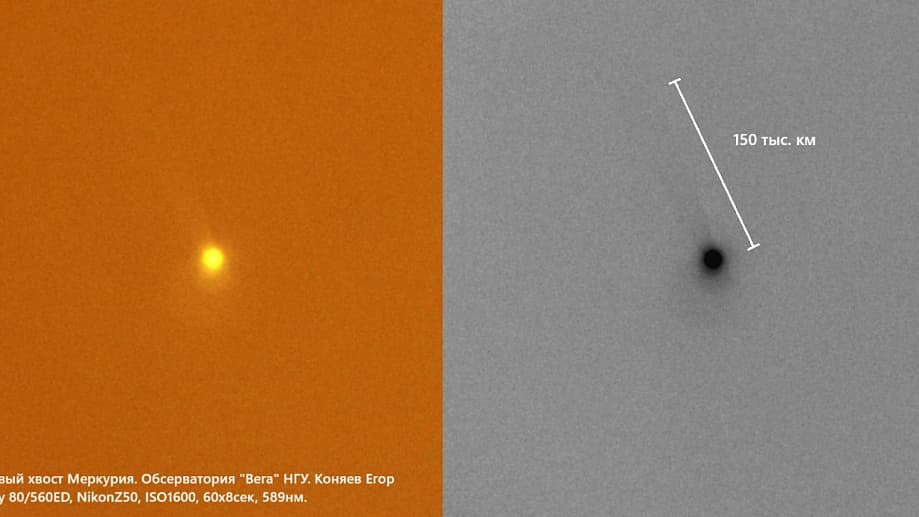
According to the Vega Observatory of NSU, the rare astronomical phenomenon was captured using a special filter that highlights the spectral region of maximum tail brightness. Its length in the image is about 150,000 kilometers. The next similar observation in Russian latitudes is possible in the spring of 2027.
The mechanism of tail formation is similar to the processes in comets. Mercury's rarefied atmosphere, consisting of helium, sodium, hydrogen, potassium, and oxygen, gradually loses atoms under the influence of the solar wind, which form a luminous trail. The tail is most pronounced in the sodium spectrum at a wavelength of 589 nanometers.
The phenomenon was discovered by astronomers in 2001. There are fewer than 20 images of it in the world, NSU noted.
Read more on the topic:
Parade of Seven Planets and Aurora Borealis Filmed from the ISS
On the Last Day of Winter, the Planets Will Align in an Invisible Parade
Now on home

Start of deliveries scheduled for 2027

Over 51,000 new motorcycles were sold in Russia in 2025

The car will take at least a year to assemble

The application's audience has reached 20 million users

The model will be included in the list of cars for taxis, price - from 2.25 million rubles

All parking lots of the "Administrator of the Moscow Parking Space" are connected to the service

The cars will be supplied to the Moscow Transport Service Directorate

Deliveries to India may begin in 2028

The technology provides automated search for all types of defects in power units

The plane flew 500 km, accelerating to 425 km/h

The plant stated that the information about the termination of purchases for models 6 and 8 is not true

Scientists are using the "Ekran-M" installation