When asteroid YR4 disintegrates in Earth's atmosphere, the energy release could reach 8 megatons in TNT equivalent. In the event of a collision of this celestial body with the Moon, a meteor shower is predicted on our planet. This was reported by astronomer Leonid Elenin, a researcher at the Keldysh Institute of Applied Mathematics of the Russian Academy of Sciences.
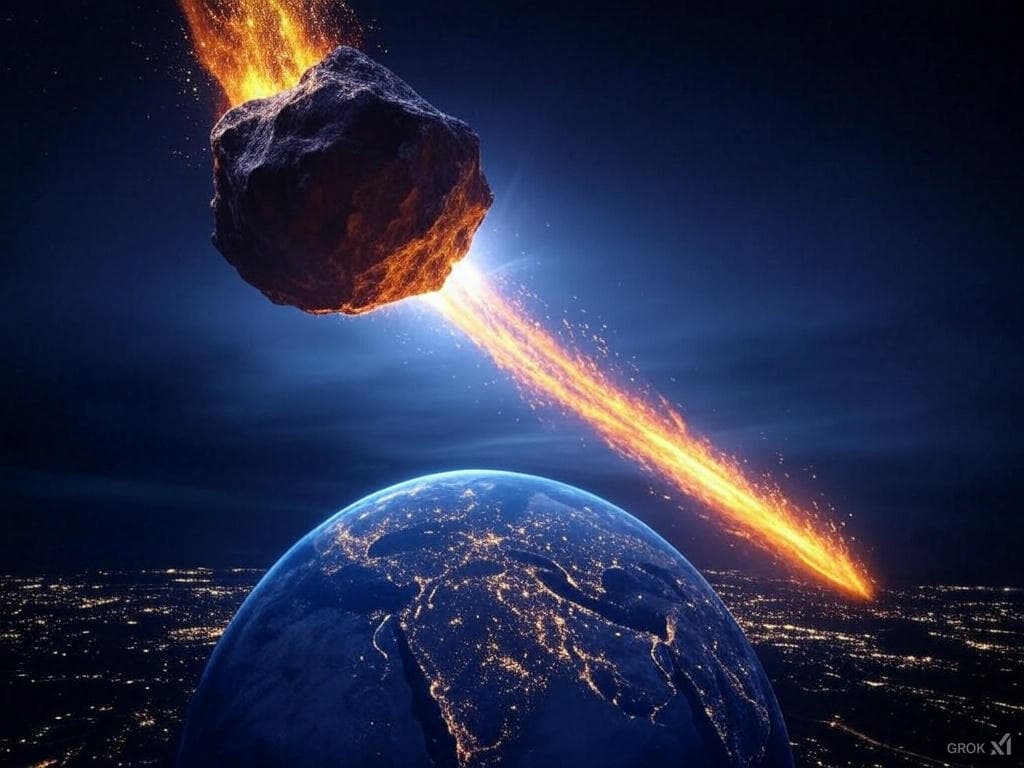
The explosion energy of asteroid 2024 YR4 is estimated at 7-8 megatons in TNT equivalent. This is approximately 20 times greater than the explosion power of the Chelyabinsk meteorite.
The scientist emphasized that if the asteroid collides with Earth in 2032, a real "regional catastrophe" will occur. Currently, experts are adjusting calculations in accordance with new data.
The orbit in the Solar System is not rails laid down once and for all. They are constantly changing, and the smaller the body and its mass, the greater the influence of the planets on it with their gravity.
According to Leonid Elenin, there is also a possibility of asteroid YR4 colliding with the Moon.
A collision with it could be dangerous for Earth because there will be a powerful explosion, with an energy release of approximately 8 megatons. The Moon has no atmosphere, low gravity, so all the ejected debris may eventually fall on our planet.
Asteroid 2024 YR4 was discovered in late December 2024 by the ATLAS network telescope in Chile. It has a diameter of 40 to 90 meters.
The celestial body may approach Earth on December 22, 2032. The National Aeronautics and Space Administration (NASA) estimated the collision risk at 2.2%. Later, this figure increased to 3.1%, but last week the indicator fell to 0.28%.
The European Space Agency (ESA) also reduced the probability of asteroid YR4 colliding with Earth to 0.002% on February 24. The exact orbit of the asteroid will only be known in 2028. This will allow for a more accurate assessment of the risks.
Read more on the topic:
Crimean Scientists Discover Over 750 Asteroids Using Soviet Telescope
Russian Scientists Share Details About the Asteroid C0WEPC5 That Fell in Yakutia