Translated with AI from the Russian original.
The SPIN-X1-MVN X-ray spectrometer began its sky survey on the ISS as part of the "All-Sky Monitor" experiment. It was installed on the external surface of the Russian segment on December 19, 2024, by cosmonauts Alexey Ovchinin, Ivan Wagner, and Alexander Gorbunov. The instrument was developed at the Space Research Institute of the Russian Academy of Sciences (IKI RAS), and RSC Energia, MCC, and the Cosmonaut Training Center are responsible for the experiment.
SPIN-X1-MVN measures X-ray radiation in the range of 6-70 keV with high accuracy. It is rigidly fixed to the station and always pointed at the zenith, allowing for a survey of the entire sky, except for the ecliptic poles, in 72 days. The main method of operation is the periodic closing and opening of four detectors by a rotating screen (shutter), which helps to isolate X-ray radiation from space.
The instrument was turned on immediately after installation. In February 2025, it was fully commissioned. Already during the first test on December 27, 2024, the instrument successfully recorded X-ray radiation from the Sun, confirming its operability. Americium-241 isotope is used for calibration, and special filters are used to account for background signals.
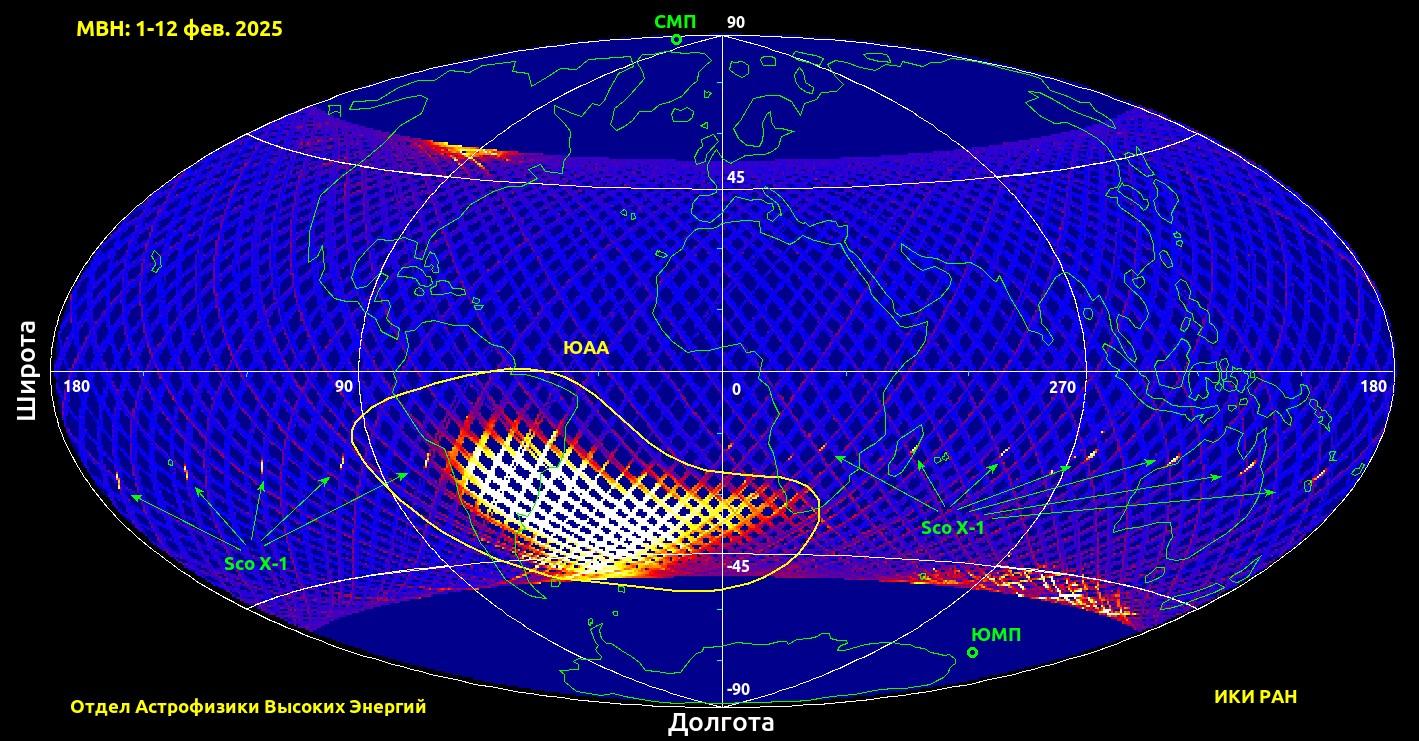
The ISS moves in a low orbit, where it is protected by the Earth's magnetic field, but periodically passes through the South Atlantic Anomaly and approaches the magnetic poles, where the flow of charged particles increases. This affects the detectors, requiring additional data filtering.
Analysis of the first data obtained showed that SPIN-X1-MVN successfully records both X-ray radiation from cosmic objects (for example, the brightest neutron star Sco X-1) and powerful bursts of charged particles near the magnetic poles. The instrument also helps to study solar activity, radiation load on detectors, and other related processes.
Read more on the topic:
Will see hogweed, pollution and fires - a Russian hyperspectrometer has started working on the ISS
The Progress MS-28 space truck was flooded in the Pacific Ocean after undocking from the ISS
The Bion-M No. 2 space mission with mice, snails and geckos has been postponed to July 2025
Never miss our newsAdd this site to your preferred sources to see us more oftenAdd on Google

















