The nuclear-powered ballistic missile submarine "Tula" of Project 667BDRM showed the reactor compartments for the first time in the "Military Acceptance" program.
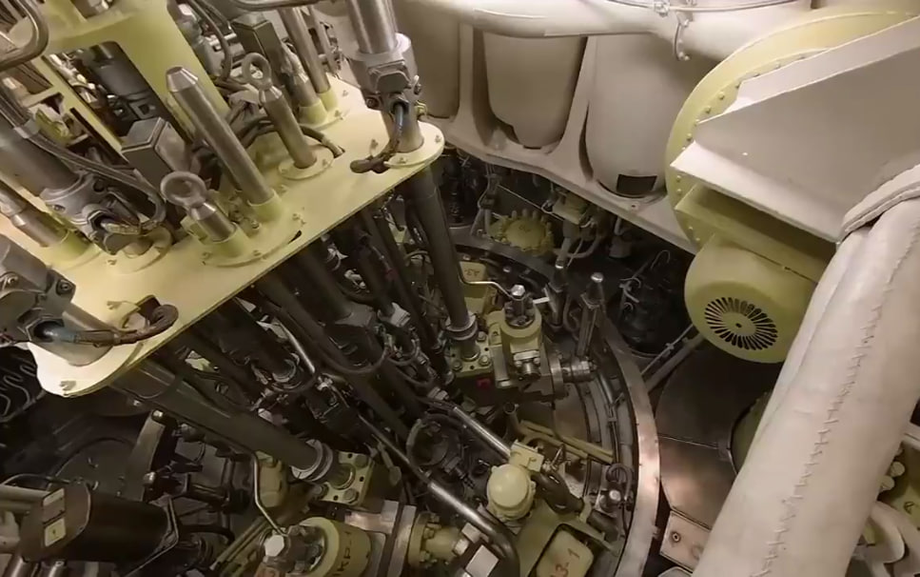
Also on the air of the Zvezda TV channel, it was announced for the first time how, in addition to size, the reactors of nuclear power plants and submarine reactors differ from each other.
The main difference is that, as a rule, the reactor at nuclear power plants is started and controlled constantly. No more [actions] are performed with it. And on a submarine, the installation is put into operation before each departure to the sea. When submerged to 50 meters, the reactor operates at 30% power, these are reduced parameters. As a rule, it very rarely reaches a hundred [one hundred percent of power usage - ed. note], we don't need it that much. That is, if we compare ourselves with multi-purpose vehicles, then we are like a truck that must deliver the necessary cargo to the right place. We must be in the right place at the right time, complete the task, and leave quietly, calmly, with a sense of accomplishment.
The missile carrier of Project 667BDRM is equipped with two "hearts" - reactors, each of which has its own separate compartment. Each reactor is hidden under a lid about a meter thick and steel protection from ionizing radiation. The reactor compartment maintains +30 degrees Celsius so that the gas cylinders needed to compensate for the volume of the heated primary coolant of the reactor always have constant pressure.
The room itself is kept in cleanliness close to a surgical operating room: surfaces are treated with alcohol and polish, and the air is ozonized. This is necessary so that fragments of dust that may be radioactive do not enter other rooms from the reactor compartment. Personnel of the nuclear submarine cannot stay in the compartments for a long time, they are considered uninhabited rooms.
Each reactor on a submarine of this project has a maximum service life of ten years, during which time it consumes a conditional"bucket of uranium". The service life could possibly be longer if it were not for the specifics of the reactor's operation, which has many on and off cycles.
Project 667BDRM
Project 667BDRM "Dolphin" is a nuclear-powered strategic missile submarine developed by TsKBMT Rubin. Submarines of the project, including "Tula", are part of the Northern Fleet. Each of them carries 16 intercontinental ballistic missiles "Sineva" and "Liner" with multiple independently targetable warheads.
Characteristics of nuclear submarines of Project 667BDRM "Dolphin":
- length overall - 167.0 m;
- maximum width - 11.7 m;
- average draft - 8.8 m;
- displacement - 18200 m³;
- working depth of immersion - 400 m;
- maximum depth of immersion - 650 m;
- full underwater speed - 23 knots;
- full surface speed - 13 knots;
- crew - 140 people;
- autonomy - 90 days.
Read materials on the topic:
Master of the Seas: Nuclear-powered missile submarine "Karelia" to complete repairs in 2025
Now on home

Start of deliveries scheduled for 2027

Over 51,000 new motorcycles were sold in Russia in 2025

The car will take at least a year to assemble

The application's audience has reached 20 million users

The model will be included in the list of cars for taxis, price - from 2.25 million rubles

All parking lots of the "Administrator of the Moscow Parking Space" are connected to the service

The cars will be supplied to the Moscow Transport Service Directorate
Deliveries to India may begin in 2028
The technology provides automated search for all types of defects in power units

The plane flew 500 km, accelerating to 425 km/h

The plant stated that the information about the termination of purchases for models 6 and 8 is not true
Scientists are using the "Ekran-M" installation