According to the press service of the Ministry of Defense, the crews of "Onega" and "Naryan-Mar" successfully completed tasks on organizing the protection and defense of a caravan of ships over the weekend. The tanker "VTR-140" and the hydrographic vessel "GS-260" played the role of a caravan of ships.
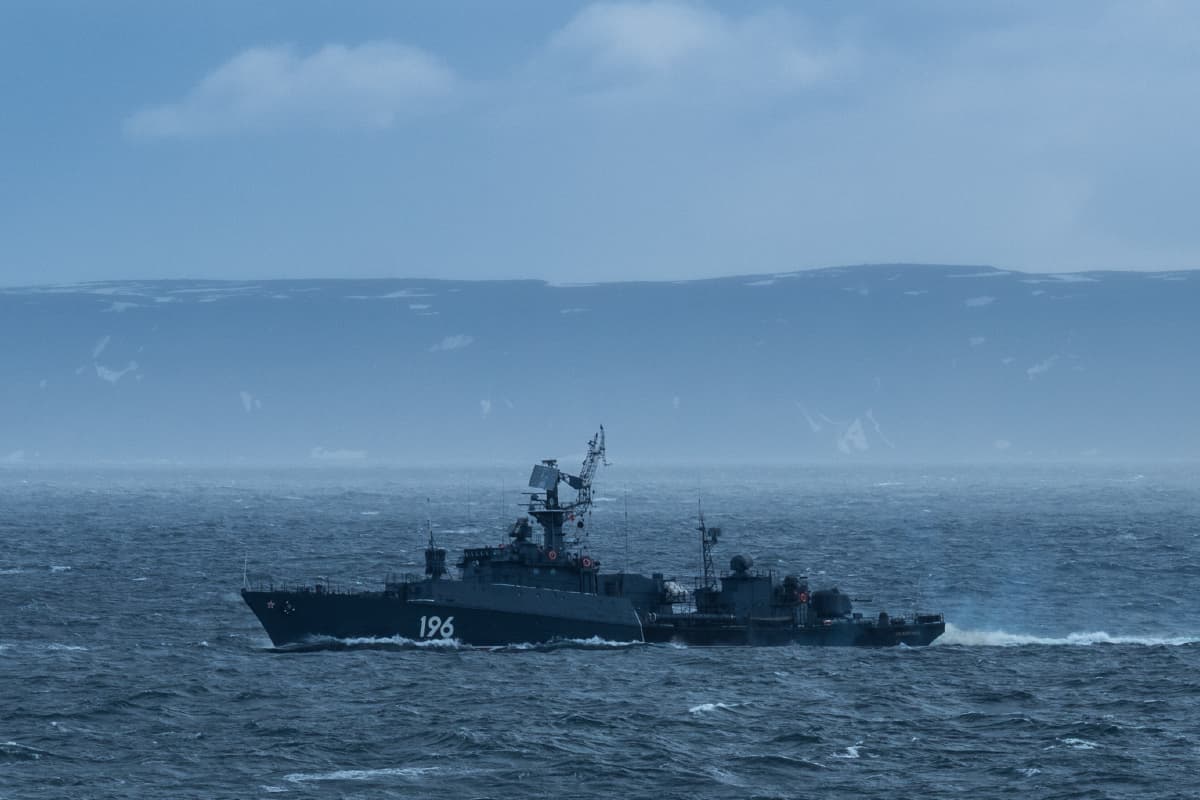
The ships practiced the organization of combat use of weapons, the use of technical means and electronic warfare equipment against a simultaneous attack by high-speed boats of a mock enemy during an attack from the air. The exercise program also included tasks to repel air attack weapons of a mock enemy.
Firing was carried out at simulated air targets by Osa-MA anti-aircraft missile systems, as well as AK-176 artillery installations and AK-630 rapid-fire 30-mm artillery automatic guns. According to the conditions of the exercise, the ships repelled a raid by mock enemy aircraft and destroyed a guided aerial bomb.
In the near future, a series of planned anti-submarine defense exercises with the use of practical weapons for small anti-submarine ships will continue.
Project 1124M
The anti-submarine ship of Project 1124M is designed for:
- fighting surface and underwater enemy independently and as part of a group;
- fighting single air targets and sabotage and terrorist forces and means;
- fire support for ground forces operating in the coastal direction;
- protection of maritime coastal communications and disruption of maritime communications of the enemy;
- performing convoy operations;
- conducting reconnaissance and carrying out patrol service.
The length of such a ship is 84 meters, the width is about 10.7 meters, and the draft is 5.2 meters. The displacement is only 1400 tons.
Ships of the project can reach speeds of up to 30 knots, stay at sea autonomously for at least 20 days, and travel up to 2,500 miles. The crew of each such vessel is 70 people.
Small anti-submarine ships of Project 1124M have a landing pad for a medium helicopter and a launch command post for its takeoff and landing. Among the weapons, the following should be highlighted:
- twin-tube torpedo launchers TPU TR-203/2 with a control system;
- mines of the MDM-1 type, mod.l or MDM-2, mod.l or UDM-E;
- anti-aircraft missile weapons in the form of Osa-MA anti-aircraft artillery complexes and others;
- artillery weapons - 100 mm - AU A-190/ A-190-01; 76.2 mm - AU AK-176MA; 57 mm AU A-220M, as well as - 30 mm AU AK-630M-06 or AU AK-306-09 or AU AK-630M-2;
- two 14.5 mm naval pedestal machine gun mounts or two 7.62 mm PKMB machine guns.
The ships are also equipped with electronic warfare equipment. In particular, these are TK-25E and MP-405-1E, which promptly detect the threat in real time and determine the optimal type of counteraction to it, plus PK-10 passive jamming complexes. If the enemy uses underwater torpedoes, they are opposed by the towed shipboard device for hydroacoustic suppression of self-guided torpedoes "Zmey".
Also, these anti-submarine ships are equipped with a hydroacoustic complex of surface ships with an antenna in the under-keel fairing from the MGK-335EM-03 "Krakva" family. According to data from open sources, these complexes search for and automatically recognize submarines, torpedoes and other enemy objects. They can also independently track the found target and issue target designation data to the fire control device of the anti-submarine defense of their carrier.
MGK-335EM-03 "Krakva" has a hydroacoustic communication function at low and high frequencies up to 20 km, the complex can also use code communication, the operating distance of which is not exactly known. It is noteworthy that this complex can provide the crew of the carrier ship with telephone communication both with Russian submarines and with ships using the NATO frequency range.
In addition to "Krakva", the ships of the project were also equipped with a hydroacoustic station with a lowered antenna module "Vesta". It can dive into the water to a depth of up to 500 meters, detect, classify and track enemy ships, submarines and torpedoes, intercept their communication with each other and archive the data obtained.
Read materials on the topic:
Explosive: experts have come up with ways to protect Russian Navy ships from enemy sea drones
"Deserves attention": the Altai "Tarantula-bird catcher" interested Poland