Scientists from the National Center for Physics and Mathematics (NCPM) and Rosatom have devised an adaptive optical system that, thanks to its record-breaking speed, compensates for the influence of atmospheric distortions on laser radiation. The development will help to obtain clearer images during astronomical observations.

What is the difficulty of astronomical observations?
The Earth's atmosphere is characterized by turbulence (a property in which pressure, temperature, speed, and wind direction change in the atmosphere), which reduces the focusing of laser radiation on an object. This also limits the resolution of telescopes when receiving images from space.
According to the scientific director of the NCPM, Alexander Sergeev, programmable logic integrated circuits (FPGAs) were used to create the adaptive optical system. They process images faster than processors.
FPGAs work not like processors, but like video cards
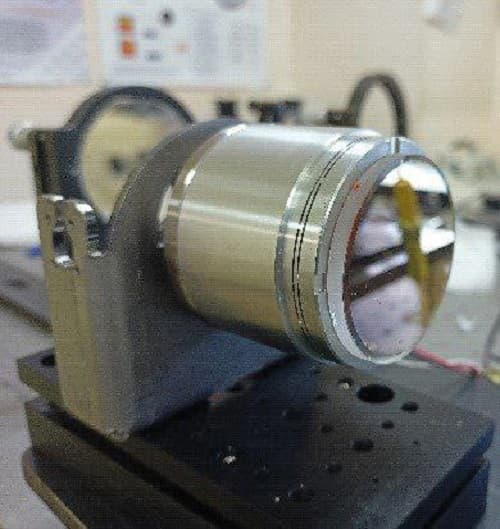
Thanks to FPGAs, the speed of the adaptive optical system in experiments in a closed space increased to 4 kHz, and in real conditions to a spacecraft - more than 2 kHz.
A level of several kilohertz allows correcting radiation distortion in a turbulent atmosphere
The development will also help to effectively focus laser radiation to achieve exawatt power at the Center for Extreme Light Field Studies of the NCPM. It will be needed as part of the work with advanced laser technologies and a "megascience" class installation in fundamental research.
Now on home

Start of deliveries scheduled for 2027

Over 51,000 new motorcycles were sold in Russia in 2025

The car will take at least a year to assemble

The application's audience has reached 20 million users

The model will be included in the list of cars for taxis, price - from 2.25 million rubles

All parking lots of the "Administrator of the Moscow Parking Space" are connected to the service

The cars will be supplied to the Moscow Transport Service Directorate

Deliveries to India may begin in 2028

The technology provides automated search for all types of defects in power units

The plane flew 500 km, accelerating to 425 km/h

The plant stated that the information about the termination of purchases for models 6 and 8 is not true
Scientists are using the "Ekran-M" installation