The development of supercomputers and new technologies in Russia, which President Vladimir Putin recently spoke about, is becoming obvious. Following the summer demonstration of a 16-qubit quantum computer by Rosatom, the country has now produced its first superconducting 8-qubit processor.
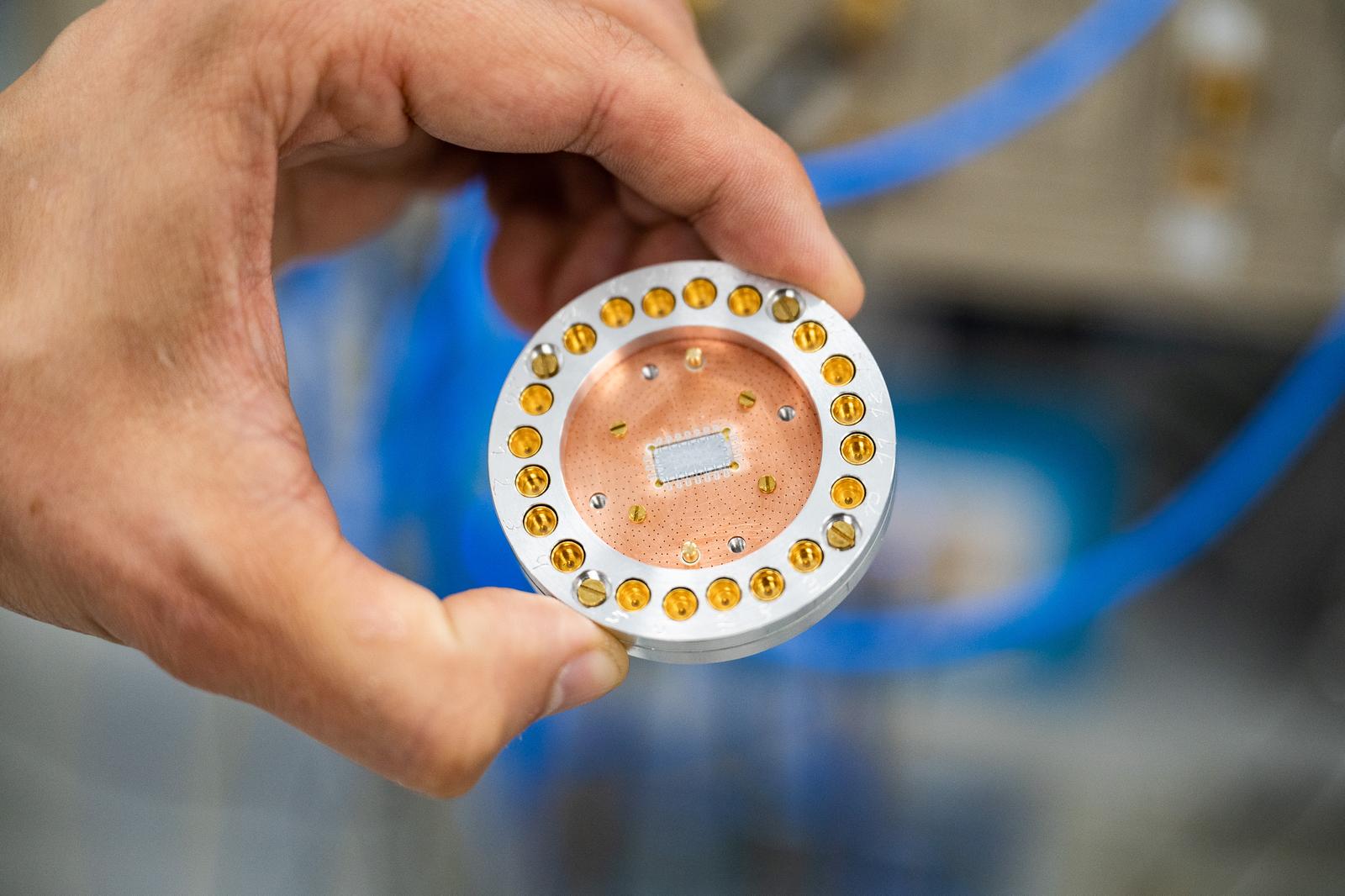
It was developed by specialists from the quantum design center of NUST MISIS with the participation of employees of the Russian Quantum Center (RQC). The processor was manufactured and implemented by a team of scientists from the Laboratory of Artificial Quantum Systems of MIPT in collaboration with colleagues from MISIS.
According to NUST MISIS, the quantum processor consists of qubits of a new type of concentric shape and tunable communication elements between them. This method of communication is now considered the most promising, as it prevents the leakage of the quantum state from the computational space.
During a control experiment with the participation of representatives of SP Quant LLC (part of Rosatom Group) and RQC, the accuracy of the two-qubit operation was demonstrated, and it turned out to be more than 95%.
At that moment, the processor was in a dilution cryostat in the Laboratory of Superconducting Quantum Technologies of NUST MISIS. The cryostat allows working with ultra-low temperatures close to absolute zero.
We have achieved a decent result. Our processor has 8 qubits, but in terms of the accuracy of two-qubit operations, it surpasses, for example, the 80-qubit processor previously presented by Rigetti, which took second place in the world in terms of the number of physical qubits among superconducting processors.
Increasing the number of qubits in a processor is not directly related to increasing its power, which is determined by the so-called quantum volume. In the simplest case, the quantum volume is proportional to the product of the number of qubits by the number of quantum operations that can be performed with a relatively small number of errors.
Therefore, achieving high accuracy in performing quantum logical operations by individual qubits plays an equally important role as increasing their number in a quantum processor.
The work was carried out within the framework of the Roadmap for the development of the high-tech field "Quantum Computing", which is supervised by Rosatom. Research will continue: their goal is to increase the quantum volume of the processor by increasing the number of qubits and the accuracy of operations.
The connection of processors by quantum communication channels for building new scalable quantum internet systems will also be worked out.
Never miss our newsAdd this site to your preferred sources to see us more oftenAdd on Google

















