A year ago, on November 21, 2024, Russiafirst used the latest medium-range ballistic missile (MRBM)"Oreshnik". According to the Russian Ministry of Defense, all warheads in non-nuclear configuration reached their targets.

The best advertising for new weapons
Footage of brightly glowing warheads spread across the web at the time, which, according to journalist Alexei Kozhevnikov, became an excellent advertisement for the new Russian weapon.
The footage of the "Oreshnik" warheads falling at the speed of punishing fire stirred up the whole world.
Military scientist-practitioner Valery Polovinkin noted that all six warheads of the missile opened at an altitude of about 100 km. He did not rule out that each warhead contains tungsten finned rods or elements of another composition based on this metal.
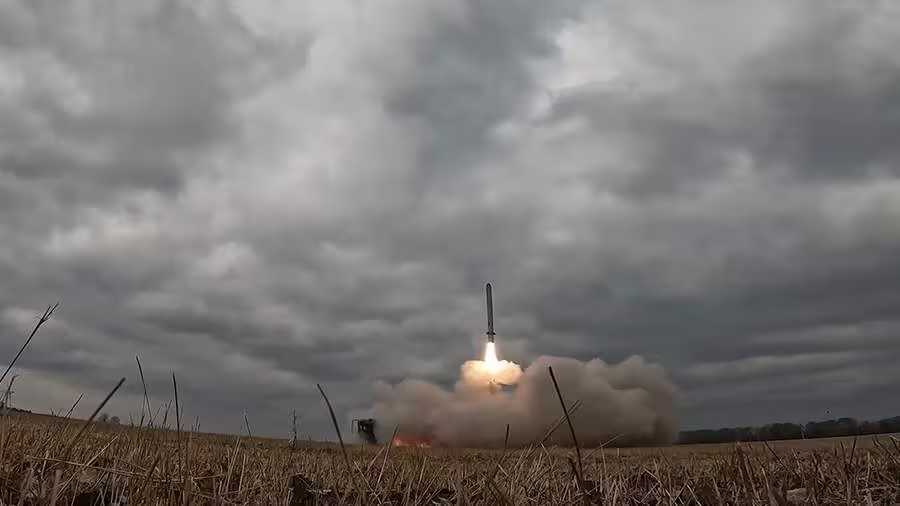
Each of these "Oreshnik" warheadscan target different targets, making the missile capable of hitting multiple locations in a single launch.
When there are truly no analogues
President Vladimir Putin noted that "Oreshnik" develops speeds of up to Mach 10. There are no countermeasures against it - the missile cannot be intercepted by either air defense or anti-missile defense systems (AD/ABM).
After the debut of "Oreshnik", Belarus made an official request to Russia to deploy the complex on its territory. The republic expects to have it on combat dutyby December 2025.
Nothing will save you from "Oreshnik" anymore. No layer of concrete and earth will withstand the impact of the "Oreshnik" warheads. One missile carries from 6 to 12 warheads. It begins to dive on the target practically from space. After separating from the missile, each warhead turns on its own engines, and they continue to accelerate until the moment of impact on the target.
The roots of "Oreshnik" go back to the USSR
The characteristics of the missile and its appearance remain classified, although something has leaked to the web. Military experts suggest that "Oreshnik" was created on the basis of the SovietPGRK RS-26 "Rubezh".
Analyst Dmitry Kornev explained that the missile carries "dozens of multiple warheads" and is designed to guarantee the destruction of airbases, underground command posts, and other critical targets.
Presumably, the speed of "Oreshnik"is over 12,000 km/h. It can carry from three to six thermonuclear warheads with a capacity of 150 kt each. The missile is solid-propellant, accelerates faster, and goes to an altitude unattainable for air defense systems.
One thousand, one and a half thousand, and more - up to 5.5 thousand - that's the range of "Oreshnik".
Each "Oreshnik" warhead is equipped with its own propulsion system, which does not allow even potential interceptors to calculate the interception point and destroy the warhead.
Read more materials on the topic:
Now on home

Start of deliveries scheduled for 2027

Over 51,000 new motorcycles were sold in Russia in 2025

The car will take at least a year to assemble

The application's audience has reached 20 million users

The model will be included in the list of cars for taxis, price - from 2.25 million rubles

All parking lots of the "Administrator of the Moscow Parking Space" are connected to the service

The cars will be supplied to the Moscow Transport Service Directorate

Deliveries to India may begin in 2028

The technology provides automated search for all types of defects in power units

The plane flew 500 km, accelerating to 425 km/h

The plant stated that the information about the termination of purchases for models 6 and 8 is not true

Scientists are using the "Ekran-M" installation