Translated with AI from the Russian original.
The first Soviet fighter with variable-sweep wing, the MiG-23, had greater payload, flight range, and improved beyond-visual-range interception capabilities compared to the MiG-21. However, this aircraft had several significant drawbacks, writes military expert Steve Balestrieri in an article for 19FortyFive.
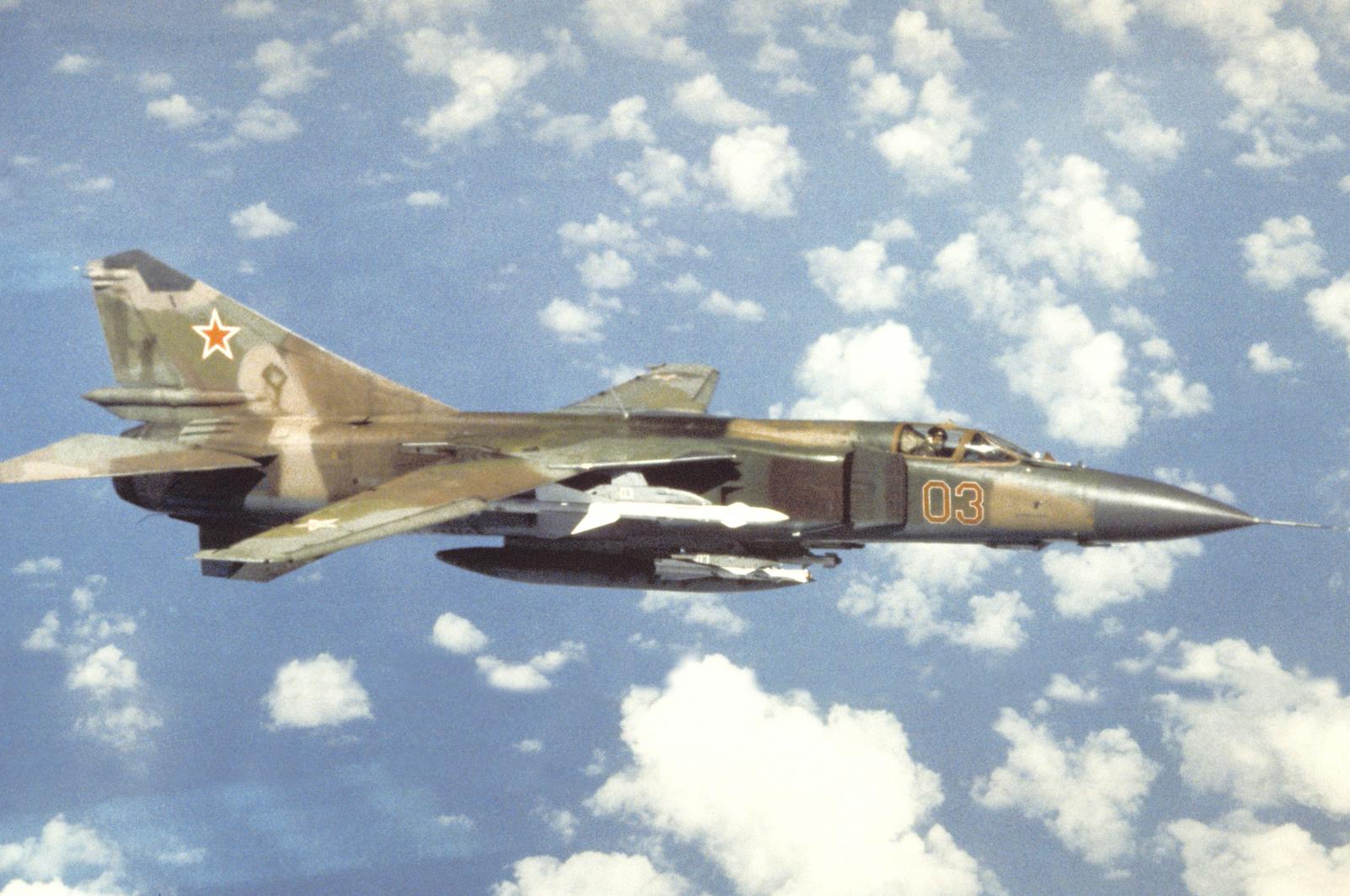
The MiG-23 had a reinforced chassis, which allowed the pilot to use short runways. It received the RP-23 "Sapfir" radar sight. Equipped with a R-29-300 turbojet engine, the aircraft could reach speeds of at least 2500 km/h.
The MiG-23MS was developed for export, so the fighter had fewer capabilities than the basic Soviet version. In total, more than 5.3 thousand MiG-23s were produced from 1969 to 1985.
Despite the advanced approach of engineers and the implemented innovations, the MiG-23 turned out to be unsuccessful. The fighter was difficult to operate and expensive to maintain. And its engines had a short service life.
Against the background of these problems, many countries of the Warsaw Pact Organization (USSR, Albania, Bulgaria, Hungary, German Democratic Republic (GDR), Poland, Romania and Czechoslovakia) decided not to remove the outdated MiG-21 from service.
More than a dozen Syrian MiG-23 fighters were shot down by Israeli F-15s and F-16s during the Arab-Israeli wars. Libyan MiG-23s were also inferior to Egyptian MiG-21s.
Pilots had to change tactics to improve the fighter's survivability. They began to adhere to the principle of "hit and run", and it worked, the expert summarized.
Read more on the topic:
MiG-31BM interceptors and Su-35S fighters received the R-37 nuclear missileM
Never miss our newsAdd this site to your preferred sources to see us more oftenAdd on Google

















