In the US, programs continue to launch for the development of advanced orbital interceptor platforms designed to detect, identify, kinetically engage, or use microwave suppression against satellites of the Russian Space Forces and the Chinese Space Forces. Analyst Evgeny Damantsev assessed domestic prospects in the event of a conflict beyond Earth.

According to him, in the coming years, the American startup True Anomaly could launch this segment. It was created by the US Space Force command and has already attracted about $250 million for the design of Jackal interceptor satellites.
Damantsev noted that promising highly maneuverable Jackal satellites may have several multi-nozzle blocks of gas-dynamic orientation engines, as well as more powerful rocket engines using gaseous fuel, or Posidon M1.5-type electric jet engines to perform long maneuvers (including approaching enemy satellites) and changing orbits.
The devices will be equipped with ultraviolet and infrared sensors, as well as AESA radars to be able to create radar portraits of target satellites at distances of tens to hundreds of kilometers.
The expert emphasized that the main advantage of such programs in the United States is going beyond the state control system, which will positively affect the rapid achievement of operational combat readiness after a series of successful field tests.
What does Russia have?
Critical groundwork in this direction also exists in Russia. In particular, serious experience has been gained in the creation and production of electric rocket engines for small spacecraft, including END, SPD-25, and AIPD-155 engines operating on ammonia, Teflon, and xenon with a power of 97, 100, and 70 - 140 W.
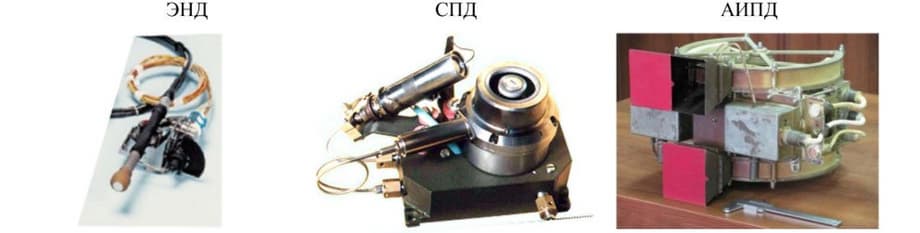
These are the KM-5 and KM-45 EREs from the Keldysh Center, as well as the TM-250 and SPD-290, which belong to high-power Hall thrusters.
There should also be no problems in creating optoelectronic and radar guidance systems for modern interceptor satellites. Fazatron-NIIR has experience in creating AESA radars (including the experimental one based on the LTCC substrate, Zhuk-AME).

Earlier www1.ru reported that UAV units appeared in the Dnepr Flotilla.
Read more materials:
KMZ repaired a diesel engine for a military ship of the Navy
Now on home

Start of deliveries scheduled for 2027

Over 51,000 new motorcycles were sold in Russia in 2025

The car will take at least a year to assemble

The application's audience has reached 20 million users

The model will be included in the list of cars for taxis, price - from 2.25 million rubles

All parking lots of the "Administrator of the Moscow Parking Space" are connected to the service

The cars will be supplied to the Moscow Transport Service Directorate

Deliveries to India may begin in 2028

The technology provides automated search for all types of defects in power units

The plane flew 500 km, accelerating to 425 km/h

The plant stated that the information about the termination of purchases for models 6 and 8 is not true

Scientists are using the "Ekran-M" installation
Articles
-
Russian An-124 "Ruslan" Stuck in Canada for 4 Years and Accrues Millions in Fines
26 Jan 2026
-
Coaxial Propellers: How Counter-Rotation Increases Turboprop Engine Efficiency
25 Jan 2026
-
Kazan Aviation Plant Breaks Old System: Tu-214 to be Assembled Like Cars
25 Jan 2026
-
How Engineers and Technicians Are Paid Today in the Russian Aviation Industry: An Overview with Figures
24 Jan 2026