Translated with AI from the Russian original.
Specialists from the V.I. Vernadsky Institute of Geochemistry and Analytical Chemistry (GEOKHI RAS) have proposed using synthetic nanodiamonds for the treatment, solidification, and disposal of radioactive waste, according to the press service of the Ministry of Education and Science of the Russian Federation.
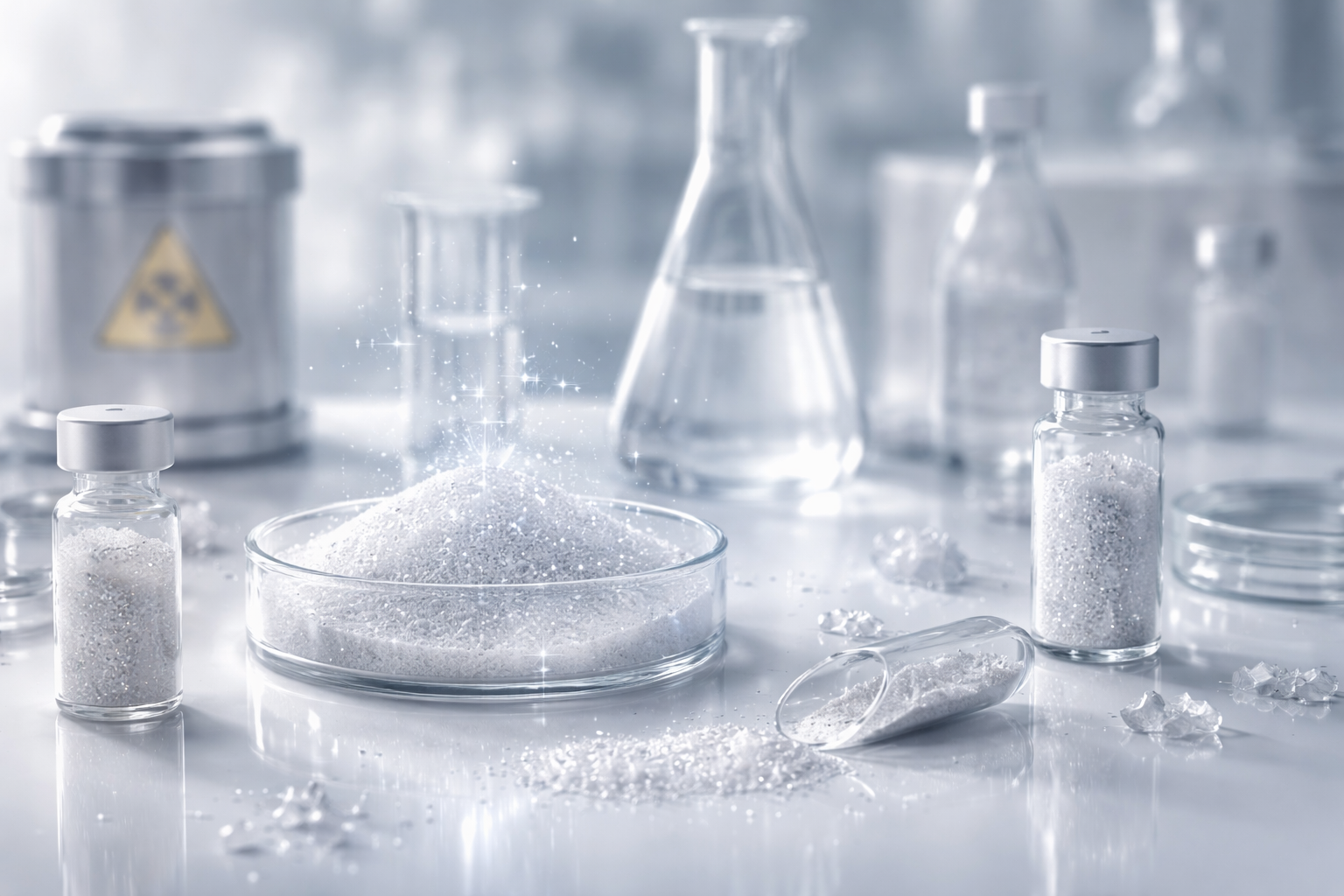
We are talking about nanodiamonds of detonation synthesis - particles of several nanometers in size, obtained by the explosion of carbon-containing substances in special chambers. This material is relatively inexpensive and significantly improves the properties of the mixture in which radioactive waste is fixed for safe storage.
According to the press service, a promising material for waste solidification is a mineral-like magnesium-potassium-phosphate (MKF) compound. Scientists have proposed adding nanodiamonds to it to increase stability. Nanodiamonds are effective as sorbents of radionuclides, have a developed surface, and are resistant to radiation and high temperatures.
The addition of nanodiamonds reduces the porosity of the compound, increases its mechanical strength, thermal conductivity and resistance to radionuclide leaching. The optimal effect is achieved by introducing one mass percent of nanodiamonds and 20 percent of wollastonite powder - a natural acicular calcium silicate, which strengthens the structure of the compound.
Read also materials:
- "Unearthed" gifts: rare diamonds in the shape of a Christmas ball and a puppy were found in the Arkhangelsk region
- Russia stopped in the growth of diamond reserves after a record 2024
- Promising diamond crystals for computer memory were obtained at the Siberian Branch of the Russian Academy of Sciences
Never miss our newsAdd this site to your preferred sources to see us more oftenAdd on Google

















