Translated with AI from the Russian original.
Geomagnetic stations around the world are recording a storm of level G4.7 - only a third of a point from the limit value of G5. This event was a consequence of the arrival to Earth of the first of three plasma clouds ejected by the Sun during a series of powerful flares in recent days. This was reported by specialists from the Laboratory of Solar Astronomy of the IKI RAS.
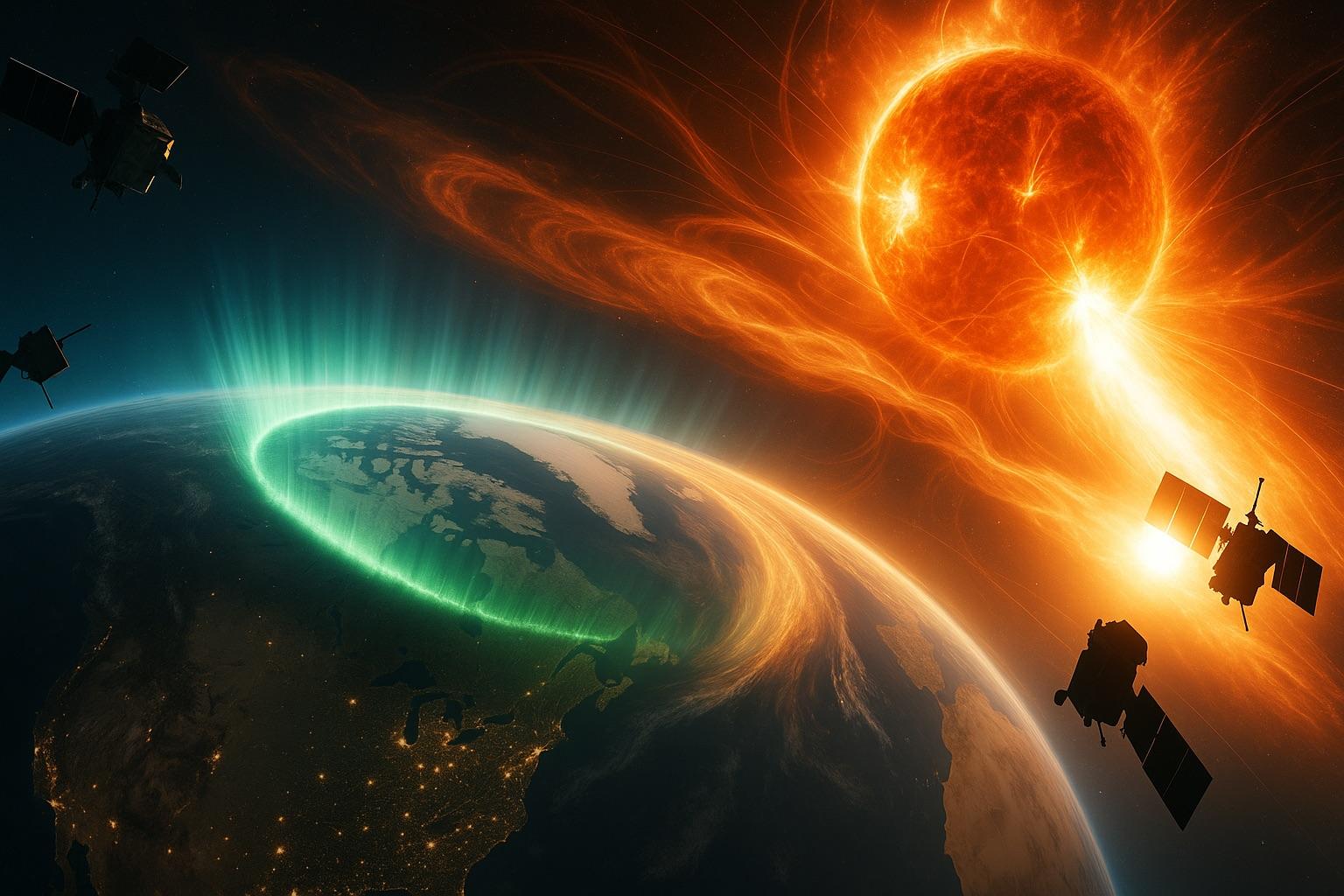
The scientists' forecasts did not come true: it was expected that only a weak front of the solar wind would reach the planet at night, capable of causing a storm no higher than level G2. However, the observed picture turned out to be much more powerful. According to experts, it is likely that the third and fastest plasma cloud, associated with yesterday's extreme X5.1 class flare - the strongest of the year - caught up and "compressed" the slower emissions, amplifying their impact. As a result, the density and temperature of the plasma increased sharply, and the magnetic field reached historical maximums.
The situation is complicated by technical failures. The main NOAA satellite for monitoring the solar wind ACE stopped transmitting data, and the agency was forced to switch to the backup DSCOVR device. Its measurements in recent hours have been unstable and contain many errors, but it is already clear that the parameters of the solar wind near the Earth are now extreme. Despite this, the flow rate remains within normal limits, which suggests that the main impact of the plasma cloud from the X5.1 flare is still ahead.
Scientists note that it is impossible to predict the further development of events - modern models are not designed for such extreme phenomena. In the coming hours, either a short-term weakening of the storm is expected, or, on the contrary, a new peak, when the main emission approaches the Earth.
A giant zone of polar auroras is forming over the planet. Its peak falls on the western hemisphere - the USA and Canada, where the auroras are visible up to the 40th parallel. According to preliminary data, northern Russia may also see unusually bright flashes in the sky.
Spacecraft are already feeling the effects of solar particles. The GOES-R satellite records a tenfold increase in the density of protons with energy above 10 MeV and a sharp increase in high-energy particle fluxes. On the SOHO space telescope, detectors are literally "blinded" by the impacts of energetic particles, which turned images of the Sun into mosaics of bright dots.
Read more materials:
- The most powerful "explosion" of 2025: a record-breaking X5.16 class flare occurred on the Sun
- Flares of the highest class do not stop: another powerful explosion was recorded on the Sun on November 10
- Maximum explosion: the most powerful flare occurred on the Sun on November 9
Never miss our newsAdd this site to your preferred sources to see us more oftenAdd on Google

















