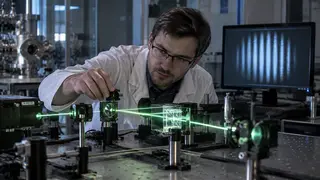
Scientists from Yaroslav the Wise Novgorod State University have modernized a vacuum deposition system used for the production of micro- and nanoelectronics components. Previously, the equipment applied thin resistive and metal layers unevenly, leading to defective products.

As part of the project, specialists created a special shutter with an opening that evenly distributes the material on the substrate and does not require disassembly of the system. The new approach proved to be cheaper than a complete replacement of the equipment - the modernization cost 15 million rubles instead of 50 million.
One of the authors of the project, Dmitry Kortsov, explained the principle of operation with an analogy to a stencil for decorating a cupcake: the "cupcake" is the product substrate, the "powder with impurities" is the resistive material, and the "sieve" is the magnetron.
The development allows improving product quality and saving plant funds while maintaining the integrity of the equipment. This is important for micro- and nanoelectronics enterprises, where the accuracy of layer deposition directly affects the reliability and functionality of finished products.
Read also:
The first production of extra-large architectural glass with magnetron sputtering started in Russia
Mi-28NM helicopters equipped with S-13DF vacuum rockets: they will break through a meter of concrete
The first production of extra-large architectural glass with magnetron sputtering started in Russia
Never miss our newsAdd this site to your preferred sources to see us more oftenAdd on Google