TASS special correspondent, cosmonaut Alexei Zubritsky, spoke about the scientific test on collaborative problem-solving, "Homeostat," which he, along with two other Roscosmos cosmonauts-Sergey Ryzhikov and Kirill Peskov-conducted aboard the International Space Station (ISS).
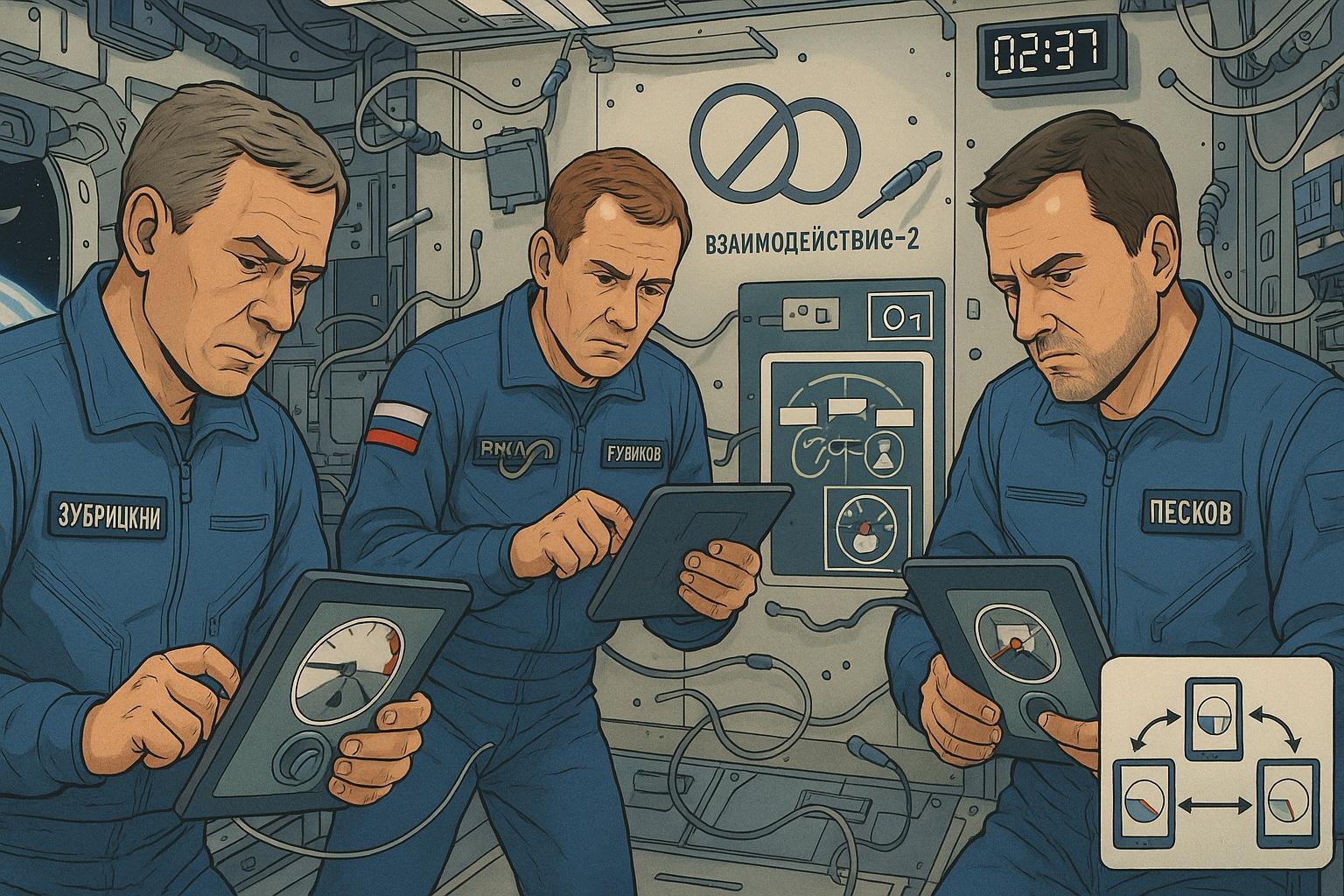
According to the cosmonaut, the essence of the methodology is to show how the crew can interact with each other without communication and jointly arrive at a solution to a single task.
In the test, each of the three participants launches an application on a tablet with a scale and an arrow, as well as a virtual wheel to control the arrow. The task is to bring the arrow to the zero mark by rotating the wheel. At the same time, the actions of one operator affect the position of the arrows of other participants. All participants do not see each other's screens and cannot communicate.
Zubritsky noted that it is necessary to perform a series of four tests lasting three minutes each-this is how much time is allotted to synchronize the arrows on all tablets. At the same time, it was not possible to achieve the goal immediately, and the results of the experiment will be analyzed only after the cosmonauts return from the expedition.
The "Homeostat" test is carried out as part of the "Interaction-2" space experiment, the purpose of which is to study the patterns of intra- and intergroup dynamics during a long-term space flight of an international crew.
It is planned that the experiment will last from 2014 to 2029. Regular testing will identify changes in crew relations, optimize psychological support, and refine recommendations for the selection and training of cosmonauts.
Read materials on the topic:
Unique crystals from space: how weightlessness improves the quality of semiconductors
Experiment "Neuroimmunity": cosmonaut Wagner showed how to collect venous blood in zero gravity
Never miss our newsAdd this site to your preferred sources to see us more oftenAdd on Google

















