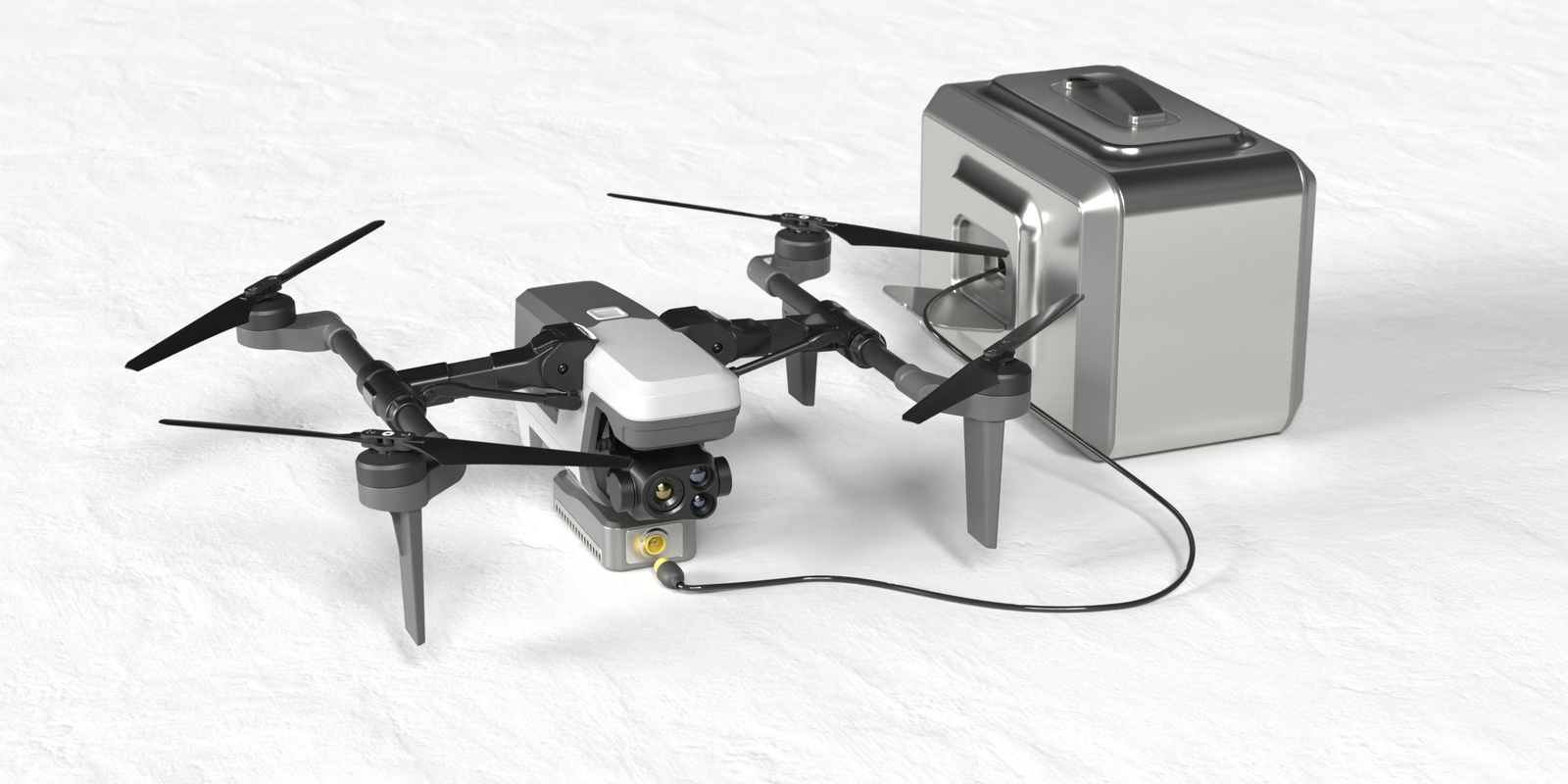
The Geoscan Group has introduced a unique modification of its flagship quadcopter, the Geoscan 801, equipped with a tethered power station. This complex solves the key problem of drones - limited flight time, allowing for continuous video surveillance for up to 6 hours.
Key features:
- Tethered station with a 50-meter cable provides constant power
- Automatic cable length adjustment depending on flight altitude
- Backup battery for safe landing in case of power outages
- Protection against overheating and short circuit
The tethered version of our flagship quadcopter for video monitoring is a product expected on the market: it allows for static video surveillance with high-definition images and thermal imaging control where the installation of stationary equipment is impossible or impractical.
Technical specifications
The complex retains all the capabilities of the basic Geoscan 801 model, including:
- High-quality video shooting
- Thermal imaging control
- Stable operation in the temperature range from -20 to +45°C
At the same time, the tethered station has compact dimensions (265×150×175 mm) and weighs only 5 kg, which makes the system mobile and easy to transport.
The complex has already been successfully tested by the EMERCOM of Sevastopol. Serial production will begin in Q3 2025. Compared to foreign analogues, the Russian development offers a more favorable price-to-performance ratio.
Read more materials on the topic:
Geoscan provides 40% of the state civil order for drones
The Moon and Mars will have domestic 3D twins: Geoscan's CubeSat satellites will be used
Never miss our newsAdd this site to your preferred sources to see us more oftenAdd on Google