Translated with AI from the Russian original.
The geomagnetic storm on the night of April 17 reached a dangerous level of G4, which corresponds to the category of "very strong" on a five-point scale. Thanks to the natural phenomenon, residents of Russia and Europe could observe the aurora borealis. However, according to the data from the Solar Astronomy Laboratory of the IKI and ISZF, the situation is expected to stabilize within 24 hours.
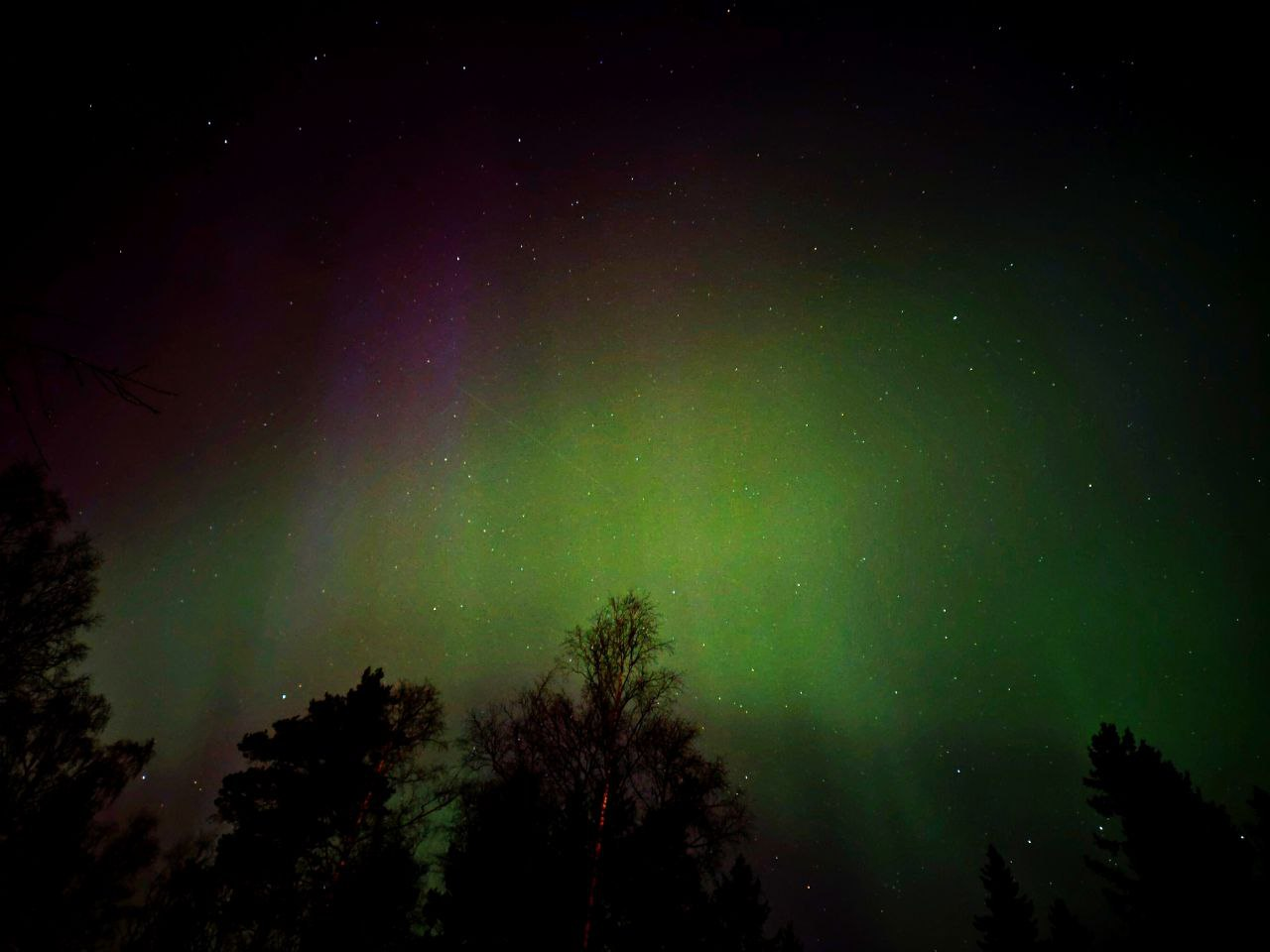
A geomagnetic storm is a disturbance of the Earth's magnetic field caused by solar activity. The storm assessment scale includes five levels: from G1 (weak) to G5 (extremely strong). At level G4, large-scale problems are observed in telecommunications, and auroras can be seen even in the tropics.
On the night of April 15 to 16, the aurora borealis lit up the sky over Tatarstan, the Moscow region, Pskov, Arkhangelsk, Sverdlovsk, and Leningrad regions. The glow reached its maximum level this year.
The powerful zone of auroras formed over Russia and Europe provided a 100% chance to see the natural phenomenon in Murmansk, Anadyr, and Salekhard. In Arkhangelsk, the chances were 80%, in St. Petersburg - 30%, and in Moscow - 14%. The conditions for observation were favorable due to the strong geomagnetic storm, the level of which was estimated as G3.3.
The geomagnetic storm that covered the Earth on the night of April 17 reached a peak close to G4.
At its peak, the Kp index of the geomagnetic field reached level 7.7, which corresponds to storms of level G3.7 on a 5-point scale. Compared to the initial forecast (G2), the absolute power of magnetic field fluctuations exceeded the calculated power by more than 4 times. The peak was passed at approximately 23:00 Moscow time.
According to the data from the Solar Astronomy Laboratory of the IKI and ISZF, the situation is expected to stabilize within 24 hours. This geomagnetic storm was the second strongest this year -- the most powerful storm G4.0 covered the Earth on January 1, 2025. In the current 11-year cycle, the event ranks 10th. The largest magnetic storms of the cycle remain the events of May 10-12 last year, when storms of the highest 5th level were recorded.
In the evening of April 16, some of the strongest auroras of the entire cycle were observed, with a noticeable lowering of the lower boundary in geographical latitude. The overall situation on the Sun has been moderately calm in recent days, so no new "shocks" are expected yet.
Read more materials on the topic:
The sun put on a fireworks display of 39 flares, almost half of them class M
Russian scientists have for the first time recorded "runaway" electrons in a laboratory sprite
Never miss our newsAdd this site to your preferred sources to see us more oftenAdd on Google

















