Translated with AI from the Russian original.
At the Samara National Research University named after Academician S.P. Korolev (Samara University), a mathematical model was created for controlling a group of satellites connected by tethers. This was reported by the press service of the university.
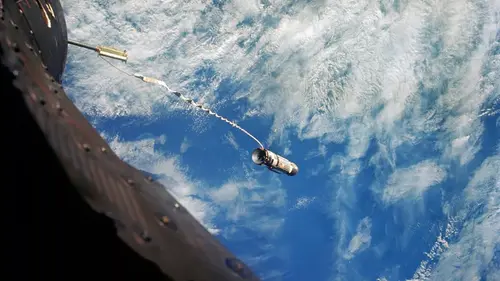
A rotating tether system is a connection of two spacecraft that function as a "space sling". At the same time, their center of mass moves along a given orbit.
Typically, such a system consists of a main satellite and a sub-satellite connected by a strong tether tens of kilometers long. Such devices open up opportunities for performing tasks that cannot be solved using traditional space technology.
The main advantage is that the new model made it possible to obtain control laws for electric motors in an analytical form in order to put the system into rotation and parry various disturbances. This will allow us to create a real space system faster.
Research has shown that the system can provide an orientation accuracy of less than one thousandth of a radian, which is equivalent to less than 0.05 degrees. In the future, it is planned to create a real space system capable of effectively removing space debris from orbit.
Earlier, www1.ru reported that the launch of four satellites was postponed to the end of 2025.
Read materials on the topic:
Chechen satellite "Nokhcho" started working in Earth orbit
Roscosmos takes control of all Russian satellites - what does this mean
More than 160 communication satellites will be launched into orbit by 2030 in Russia
Never miss our newsAdd this site to your preferred sources to see us more oftenAdd on Google

















